
Genesis 29:1–8 (AMP)
1 Then Jacob went on his way and came to the land of the people of the East [near Haran].
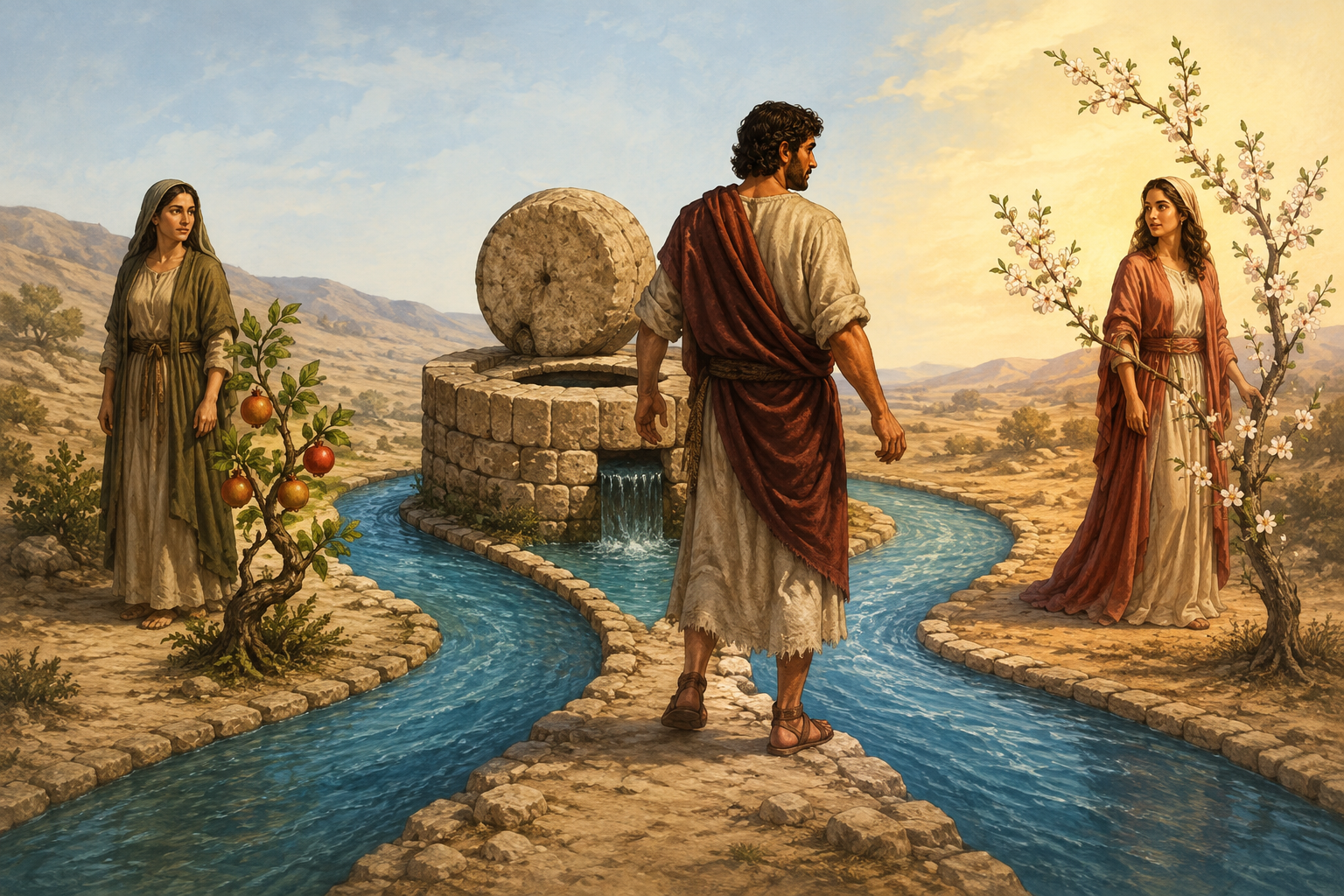
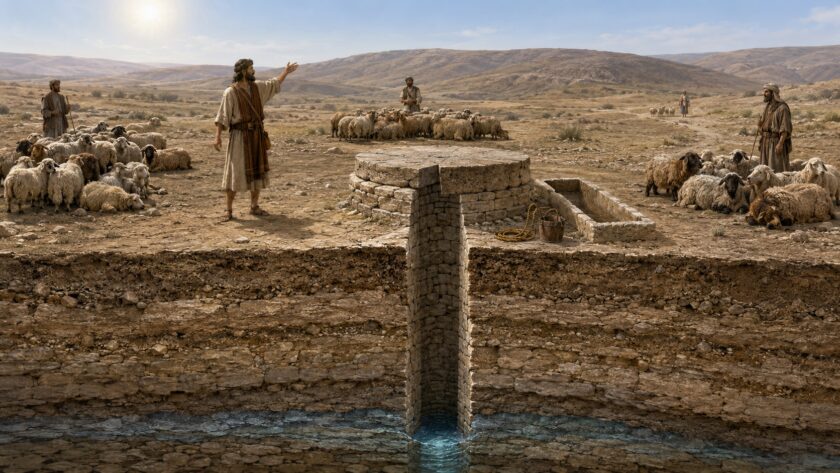
2 As he looked, he saw a well in the field, and three flocks of sheep lying there [resting] beside it because the flocks were watered from that well. Now the stone on the mouth of the well [that covered and protected it] was large,
3 and when all the flocks were gathered there, the shepherds would roll the stone from the mouth of the well, water the sheep, and [afterward] replace the stone on the mouth of the well.
4 Jacob said to them, “My brothers, where are you from?” And they said, “We are from Haran.”
5 So he said to them, “Do you know Laban the grandson of Nahor [Abraham’s brother]?” And they replied, “We know him.”
6 And he asked them, “Is it well with him?” And they said, “He is doing well; look, here comes his daughter Rachel with the sheep!”
7 Jacob said, “Look, the sun is still high [overhead]; it is a long time before the flocks need to be gathered [in their folds for the night]. Water the sheep, and go, and return them to their pasture.”
8 But they said, “We cannot [leave] until all the flocks are gathered together, and the shepherds roll the stone from the mouth of the well; then we will water the sheep.”
⸻
🔬 Metabolic Commentary — Arrival at a Gated Resource
Jacob leaves Bethel with the promise still echoing and the stone he raised as a marker standing behind him.
“Then Jacob went on his way.”
The Hebrew phrase carries the bodily sense preserved in the AMP footnote: Jacob raised his feet. What he received during the night now becomes movement. God did not give him a map of the journey or explain what would happen when he arrived. He gave Jacob orientation—presence, protection, return, and a promise extending through descendants who did not yet exist.
Jacob gets up and walks inside that promise.
He continues eastward until he reaches the land toward which he was sent. There, the first concrete thing he finds is a well.
Three flocks already lie beside it. The water is present beneath the ground, but a large stone covers the opening. The shepherds follow an established order: the flocks gather, the stone is rolled away, the animals drink, and the stone is returned.
The resource is present.
Access is delayed.
In ecology, the presence of a resource and access to that resource are not the same thing. An animal may possess the strength to travel and know the direction it must move, yet still depend upon water located outside its own body. Terrain, physical barriers, group behavior, and shared timing determine whether that water can actually be reached. The well contains what the flocks need, but the established pattern governs when its opening becomes available.
Arrival at the resource does not open the resource.
Jacob begins asking questions.
“My brothers, where are you from?”
They are from Haran.
“Do you know Laban?”
They know him.
“Is it well with him?”
He is well.
With each answer, the foreign landscape becomes more recognizable. Jacob has found the region, confirmed the family connection, and learned that Laban’s daughter Rachel is approaching with the sheep. Kinship, water, and the household he hopes to enter are all drawing near.
But Jacob does not simply accept what he sees.
The sun remains high. The sheep could be watered and returned to pasture. From his perspective, useful time is being lost while animals rest beside a resource they cannot reach. He immediately proposes another arrangement:
“Water the sheep, and go, and return them to their pasture.”
The impulse is familiar. This is the same man who once rearranged the conditions around his father so that events would move in the direction he preferred. He has already learned that timing, perception, and circumstance can sometimes be arranged to produce a desired outcome.
Now he has entered an order he did not create.
The shepherds answer, “We cannot [leave] until all the flocks are gathered together.”
Their words do not mean that the stone is physically immovable or that the water is inaccessible forever. They identify the condition governing its use. Jacob sees remaining daylight and an opportunity to act; the shepherds see a gathering that has not yet reached its required threshold.
For the first time in this new land, Jacob’s preferred course meets conditions belonging to someone else.
This is not yet a lesson in helplessness. Jacob still possesses strength, initiative, and the ability to act. The journey itself proves that. But strength and control are not the same. A person may move what is directly before him without determining the larger order in which he now lives.
Jacob has reached the correct place.
He has found the necessary resource.
He has received signs that his mother’s family is near.
Yet arrival has not placed the environment under his authority.
The promise remains intact.
The water remains beneath the stone.
Rachel is approaching.
And Jacob is about to discover how much one determined man can move—and how much he cannot.
Genesis 29:9–14 (AMP)
9 While he was still speaking with them, Rachel came with her father’s sheep, for she was a shepherdess.
10 When Jacob saw [his cousin] Rachel, the daughter of Laban, his mother’s brother, and Laban’s sheep, he came up and rolled the stone away from the mouth of the well and watered the flock of Laban, his uncle.
11 Then Jacob kissed Rachel [in greeting], and he raised his voice and wept.
12 Jacob told Rachel he was her father’s relative, Rebekah’s son; and she ran and told her father.
13 When Laban heard of the arrival of Jacob, his sister’s son, he ran to meet him, and embraced and kissed him and brought him to his house. Then he told Laban all these things.
14 Then Laban said to him, “You are my bone and my flesh.” And Jacob stayed with him a month.
⸻
🔬 Metabolic Commentary — Recognition Releases Directed Effort
Rachel arrives while Jacob is still speaking.
Nothing about the well itself has changed. The stone remains where it was. The local custom remains in place. The shepherds who told Jacob, “We cannot [leave] until all the flocks are gathered together,” are still standing there.
What changes is what Jacob now recognizes within the scene.
“Rachel came with her father’s sheep.”
A moment earlier, Jacob was surrounded by strangers in an unfamiliar land, asking questions to determine whether he had even reached the right household. Now the answer approaches on foot. Rachel is not simply another shepherd bringing another flock. The men have already identified her as Laban’s daughter, and Laban is the brother of Jacob’s mother.
Suddenly the landscape has a human connection.
The text emphasizes that connection almost insistently:
“When Jacob saw Rachel, the daughter of Laban, his mother’s brother, and Laban’s sheep…”
Rachel is Laban’s daughter.
Laban belongs to Rebekah’s family.
And Jacob is Rebekah’s son.
The foreign environment has become legible.
Then Jacob acts.
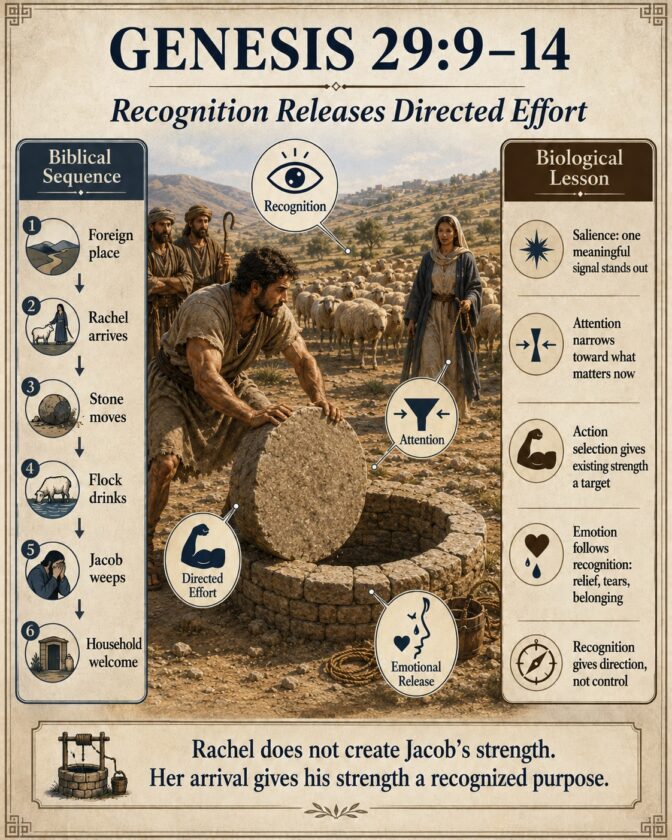
“He came up and rolled the stone away from the mouth of the well and watered the flock.”
The stone had been sitting in front of him throughout the previous conversation. Jacob had already noticed the unused daylight. He had already questioned why the sheep were waiting. Whatever physical capacity he uses now was therefore present before Rachel arrived.
Rachel does not create Jacob’s strength.
Recognition gives that strength a direction.
The brain is continually surrounded by more information than it can treat as equally important. Sounds, faces, movement, memory, physical sensation, and possible actions compete for limited attention. Something must decide what matters now.
Neuroscience calls this salience.
Networks involving the anterior insula and anterior cingulate help identify information that deserves priority, while norepinephrine released from the locus coeruleus can increase the brain’s responsiveness to important signals. Attention becomes more selective. Competing information is pushed toward the background. Motor circuits can then favor one action over the many movements the body was capable of making all along.
None of this creates energy from nothing.
It changes which possibility receives access to the energy already available.
That distinction is important beside the well.
Jacob could see the stone before Rachel arrived. He could see the sheep. He could see that daylight remained. Yet none of those observations had caused him to move it.
Then the scene acquires personal meaning.
The daughter of the family he has traveled to find is standing beside the resource.
Attention narrows.
Action becomes specific.
The stone moves.
The flock drinks.
This is one of the ordinary marvels of a living nervous system: the same muscles can remain idle before one arrangement of information and become immediately purposeful before another. Strength matters, but strength alone does not determine behavior. Perception must first establish what the effort is for.
Only after the physical work is done does another response appear.
“Then Jacob kissed Rachel [in greeting], and he raised his voice and wept.”
Genesis does not tell us exactly why Jacob cries, and the biology should not pretend to know what the text leaves open. He has left his parents, fled the conflict with his brother, slept alone on the road, awakened to the presence of God, and traveled into a country he does not know. Now, for the first time since leaving home, a living connection to his own family stands directly before him.
Emotion is not separate from recognition. The brain does not merely identify what something is; it also evaluates what that thing means to the person. When significance changes suddenly, the response can spread beyond thought into breathing, muscle tension, voice, facial expression, and tears. The body participates in meaning.
Jacob’s does.
First the stone moves.
Then the voice breaks.
He tells Rachel who he is:
“Rebekah’s son.”
That identification matters. Jacob does not enter this household by presenting wealth, status, or accomplishment. His connection is relational. The mother whose household he has just left becomes the name by which he is recognized in the household he has reached.
Rachel responds with movement of her own.
“She ran and told her father.”
Recognition now travels ahead of Jacob.
Laban hears that his sister’s son has arrived, runs to meet him, embraces him, kisses him, and brings him into his house. The movement that began with Rachel approaching the well now reverses direction. Jacob moves toward Rachel. Rachel runs toward Laban. Laban runs toward Jacob.
One recognized relationship activates another.
Human beings do this constantly. A place becomes easier to navigate when its signals acquire meaning. A stranger becomes kin when the relationship is identified. Uncertainty decreases as names attach to people, people attach to relationships, and relationships create expectations about what can happen next.
The land itself has not changed.
Jacob’s relationship to it has.
Laban gives the transition its clearest language:
“You are my bone and my flesh.”
Jacob has not yet negotiated wages. He has not yet asked for Rachel. No marriage agreement has been made. For a month, the narrative simply places him inside the household.
That restraint matters. The chapter will soon ask what Jacob is willing to work for, but first it establishes something more basic: the man who arrived as an unknown traveler has found the people he was sent to find.
At the beginning of the chapter, Jacob possessed direction without local belonging. At the well, the resource was present but access remained governed by conditions outside him.
Then Rachel appeared.
The stone moved.
The sheep drank.
The tears came.
The message traveled.
And Jacob entered the house.
Recognition has not given him control.
It has done something more immediate.
It has taught his attention what matters, given his strength somewhere to go, and turned an unfamiliar place into a place where action finally has a name.
Genesis 29:15–20 (AMP)
15 Then Laban said to Jacob, “Just because you are my relative, should you work for me for nothing? Tell me, what should your wages be?”
16 Now Laban had two daughters; the name of the older was Leah, and the name of the younger was Rachel.
17 Leah’s eyes were weak, but Rachel was beautiful in form and appearance.
18 Jacob loved Rachel, so he said, “I will serve you [as a hired workman] for seven years [in return] for [the privilege of marrying] Rachel your younger daughter.”
19 Laban said, “It is better that I give her [in marriage] to you than give her to another man. Stay and work with me.”
20 So Jacob served [Laban] for seven years for [the right to marry] Rachel, but they seemed like only a few days to him because of his love for her.
⸻
🔬 Metabolic Commentary — Love Organizes Long-Term Investment
A month has passed inside Laban’s household.
Jacob is no longer the traveler standing beside a closed well. He has been received as kin—“bone and flesh”—and has already begun to work. Recognition gave his strength an immediate direction when Rachel appeared. Now Laban asks the question that turns that direction into a long-term arrangement.
“Tell me, what should your wages be?”
The question sounds fair. Kinship does not mean Jacob should labor indefinitely without return. Yet something important has already shifted. Jacob may name what he wants, but the fulfillment of that desire will remain inside Laban’s household and therefore within Laban’s control.
The text pauses to place both daughters before us.
“Now Laban had two daughters; the name of the older was Leah, and the name of the younger was Rachel.”
Leah’s eyes are described as weak. Rachel is described as beautiful in form and appearance. Genesis does not yet explain what these differences will mean. It simply lets the two women stand within the same household before telling us where Jacob’s affection has settled.
“Jacob loved Rachel.”
That sentence organizes the next seven years.
Jacob does not ask for livestock, silver, or land. He names a person.
“I will serve you… for seven years… for Rachel your younger daughter.”
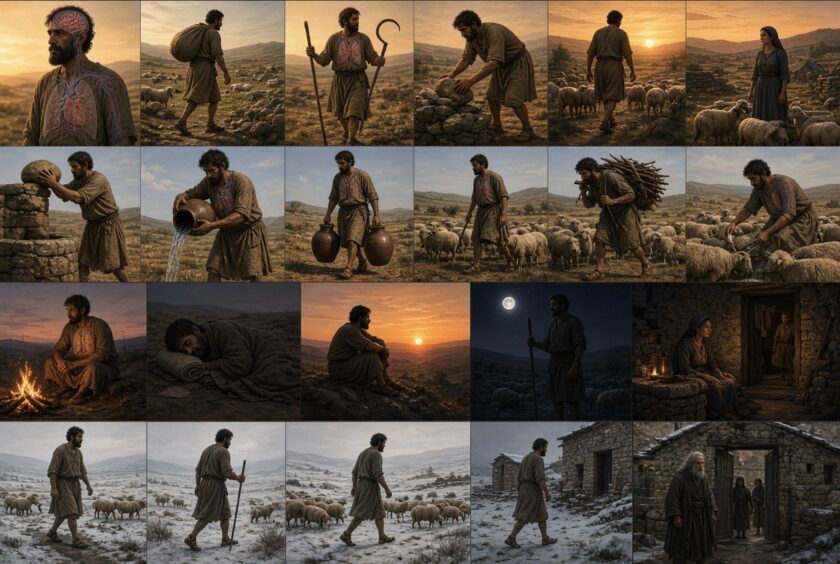
At the well, Rachel’s arrival released a burst of physical effort. Jacob saw her, moved the stone, and watered the flock. Now the scale changes completely. What required strength for a moment becomes endurance across years.
Love has moved from recognition into investment.
Living bodies continually weigh future reward against present cost. Effort requires energy. Delay requires patience. And ordinarily, something promised far in the future loses some of its motivational force simply because it is distant. Behavioral science describes part of this as delay discounting: immediate rewards tend to exert greater pull than rewards that must be waited for.
Effort is weighed as well. The nervous system does not merely ask whether an outcome is desirable. It continually evaluates whether that outcome remains worth the energy, time, uncertainty, and repeated action required to reach it.
This is protective. A living creature that spent unlimited energy pursuing every distant possibility would quickly exhaust itself.
But some futures retain their value.
Rachel does.
The labor remains physically real. Muscle still consumes ATP. Energy stores must still be replenished. Tissue still requires repair. Hunger returns. Sleep is necessary. Summer does not cool because Jacob is in love, and winter does not shorten.
The body pays the seven years in full.
What changes is the value assigned to paying them.
Dopamine participates in motivated pursuit and in learning which outcomes deserve continued effort, but love cannot be reduced to dopamine or any other single chemical signal. Human attachment draws together recognition, memory, anticipation, emotion, social bonding, and reward. A particular person becomes different from an interchangeable reward because that person has acquired a distinct place within the individual’s future.
Jacob is not working toward marriage in the abstract.
He is working toward Rachel.
That distinction gives the labor coherence.
A task experienced only as expenditure is counted in what it takes away: another hour, another day, another measure of strength. Attach the same effort to something deeply valued and its physical cost does not disappear, but its meaning changes.
Expenditure becomes investment.
Laban accepts Jacob’s offer.
“It is better that I give her to you than give her to another man. Stay and work with me.”
The agreement appears settled. Jacob has named the woman he loves. Laban has acknowledged the arrangement. Seven years now stand between Jacob and the future he has chosen.
And Genesis passes over those years in a single sentence.
“So Jacob served Laban for seven years… but they seemed like only a few days to him because of his love for her.”
The text does not say the work was easy.
It does not say the years became shorter.
Seven years remained seven years.
The flocks still required care. Days still became seasons. The body still experienced fatigue, recovery, hunger, and age. What changed was the subjective weight of the interval.
Human beings do not experience time and effort as perfectly objective quantities. Attention, expectation, emotion, and meaning influence how duration is remembered and how burdensome effort feels. A distant outcome that remains deeply significant can continue pulling behavior forward even while the body pays a real cost in the present.
That is exactly what the verse allows us to see.
Love does not remove labor.
It makes labor intelligible.
At the well, recognition organized Jacob’s strength for a moment.
Now attachment organizes his life across years.
The stone required a burst of effort.
Rachel sustains a direction.
And still, one quiet distinction remains.
Jacob controls the labor he is willing to give.
Laban controls what will be given in return.
For seven years, that tension remains hidden beneath an apparently simple agreement.
The body works.
The days accumulate.
The future remains ahead.
And because Jacob loves Rachel, the distance between them remains worth crossing.
Love does not shorten the seven years.
It makes the seven years worth spending.
Genesis 29:21–30 (AMP)
21 Finally, Jacob said to Laban, “Give me my wife, for my time [of service] is completed, so that I may take her to me [as my wife].”
22 So Laban gathered together all the men of the place and prepared a [wedding] feast [with wine].
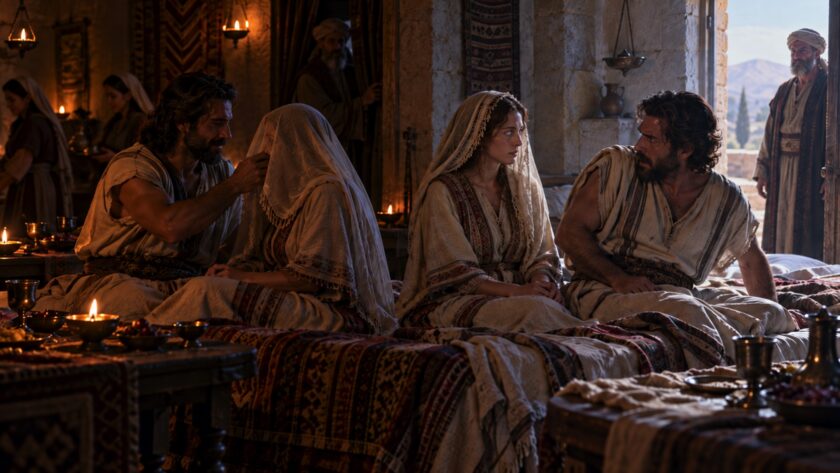
23 But in the evening he took Leah his daughter and brought her to Jacob, and Jacob went in to [consummate the marriage with] her.
24 Laban also gave Zilpah his maid to his daughter Leah as a maid.
25 But in the morning [when Jacob awoke], it was Leah [who was with him]! And he said to Laban, “What is this that you have done to me? Did I not work for you [for seven years] for Rachel? Why have you deceived and betrayed me [like this]?”
26 But Laban only said, “It is not the tradition here to give the younger [daughter in marriage] before the older.
27 Finish the week [of the wedding feast] for Leah; then we will give you Rachel also, and in return you shall work for me for seven more years.”
28 So Jacob complied and fulfilled Leah’s week [of celebration]; then Laban gave him his daughter Rachel as his [second] wife.
29 Laban also gave Bilhah his maid to his daughter Rachel as a maid.
30 So Jacob consummated his marriage and lived with Rachel [as his wife], and he loved Rachel more than Leah, and he served with Laban for another seven years.
⸻
🔬 Metabolic Commentary — Recognition Defeated by Controlled Conditions
The seven years have been paid.
Jacob does not ask Laban whether the agreement still stands. He speaks as a man who believes the return has come due.
“Give me my wife, for my time is completed.”
Love organized those years. The labor was real. The body paid them in full. What Jacob now claims is the future those years were spent to reach. He names the woman he has already chosen: “my wife.” In his understanding, the pairing has been settled. Only the household’s public act remains.
Laban gathers the men of the place and prepares a feast.
From Jacob’s perspective, the sequence confirms everything he already expects. The labor is complete. The agreement has been acknowledged. The wedding feast has begun.
Every surrounding signal points toward the same conclusion:
Rachel.
Then evening comes.
And Laban acts.
“In the evening he took Leah his daughter and brought her to Jacob, and Jacob went in to her.”
The text does not explain every covering, every silence, or every detail that allowed the substitution to succeed. It gives us something more important.
It gives us the conditions.
Night.
Expectation.
A wedding feast.
A bride delivered by the father who controls the household.
Seven years spent moving toward one particular woman.
Human recognition does not begin from nothing each time we encounter the world. The brain combines incoming sensory information with memory, expectation, context, and prior experience to determine what is most likely before us. Usually this makes perception fast and remarkably reliable. We do not need to verify every familiar object or person from the ground up each time we see them.
Expectation helps recognition.
But expectation can also fill missing information.
Vision normally supplies some of the richest information available for identifying another person. When light is poor, that information becomes less reliable, and the brain naturally leans more heavily upon whatever remains—touch, voice, circumstance, memory, and what the situation has already taught it to expect.
Jacob has spent seven years expecting Rachel.
The feast confirms Rachel.
The completed contract confirms Rachel.
Laban’s authority confirms Rachel.
The night removes much of the information most capable of contradicting Rachel.
Under those conditions, Jacob does not need to invent a false reality.
Laban has arranged one around him.
This is where Genesis 29 quietly reaches backward into Genesis 27.
Isaac once tried to recognize a son under degraded perception. Voice argued for Jacob. Hands argued for Esau. Smell, food, touch, memory, and expectation competed until the accumulated evidence crossed a threshold and Isaac committed.
Jacob now experiences the same vulnerability from the opposite side.
But there is an important difference.
Isaac received conflicting signals.
Jacob is largely denied them.
The conflict is hidden rather than argued.
The night does not present him with two competing identities. It presents one anticipated identity under conditions that prevent the most useful test.
Jacob does not ask, “Are you really Rachel?”
The feast, the hour, the agreement, and the woman brought to him already appear to answer a question he believes was settled seven years earlier.
So he goes in.
Then morning supplies what night withheld.
“It was Leah.”
Nothing about Leah changes at sunrise.
The information changes.
Light restores visual detail. Morning creates a prediction error: everything Jacob expected is suddenly contradicted by what the light makes undeniable. Small mismatches of this kind are corrected constantly, often without notice. When the difference is large and consequential, attention surges, arousal rises, and the picture the mind has been carrying is forced to revise.
Rachel is not there.
Leah is.
Recognition returns to what the light now makes undeniable.
The mind can update immediately.
The event cannot.
That distinction is crucial.
Recognition may change in a moment.
Some commitments do not.
Jacob can understand what happened. He can confront Laban. He can name Leah accurately. He can identify the deception.
None of those corrections can restore the previous evening.
His protest therefore joins labor, person, and betrayal together:
“Did I not work for you for Rachel? Why have you deceived and betrayed me?”
The problem is not merely that Jacob failed to see.
The conditions of seeing were controlled.
Laban does not deny what he has done.
He relocates it inside custom.
“It is not the tradition here to give the younger before the older.”
The younger son who once moved ahead of his older brother now stands in a household that will not let the older daughter be passed over for the younger. Firstborn precedence returns, not as Isaac’s trembling blessing, but as a local rule spoken after the night has already made it binding.
Genesis does not need to stop and explain the irony.
It simply places Jacob inside it.
Laban then converts the exposed deception into another agreement.
“Finish the week for Leah; then we will give you Rachel also, and in return you shall work for me for seven more years.”
What morning clarifies, morning cannot undo.
Once an action has been carried past a threshold, later knowledge can redirect what happens next without restoring the life that existed beforehand. The blessing Isaac could not recall and the marriage Jacob cannot unmake belong to the same kind of moment: recognition arrives, and the commitment remains.
The information changes.
The history remains.
Jacob completes Leah’s week.
Rachel is given.
Another seven years of labor are imposed.
And the text records the resulting division without yet resolving it:
“He loved Rachel more than Leah.”
Preference survives.
The household has changed.
At the well, recognition released Jacob’s strength.
Across seven years, love organized his endurance.
On this night, controlled conditions defeat the recognition that love had trusted.
Jacob could name his wage.
He could decide how much labor he would give.
He could remain oriented toward Rachel for seven years.
But he could not control what Laban placed inside the darkness between effort and fulfillment.
The body had already completed the work.
Morning completed the knowledge.
And knowledge, arriving after commitment, could expose the substitution—
but it could not undo the night.
Genesis 29:31–35 (AMP)
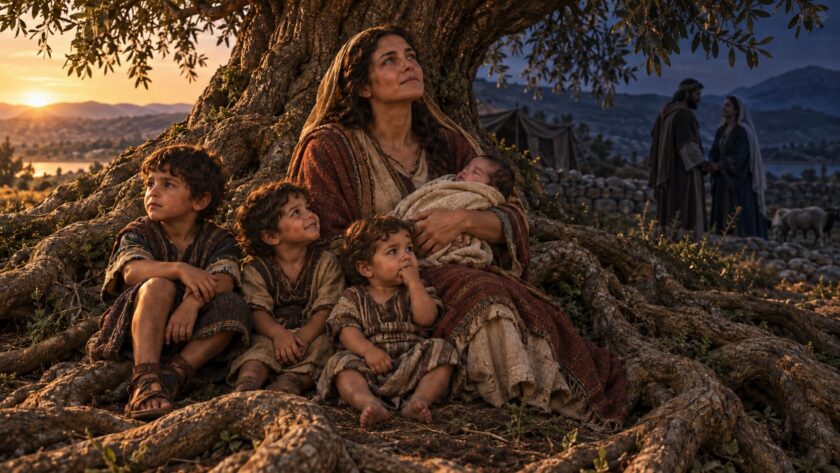
31 Now when the LORD saw that Leah was unloved, He made her able to bear children, but Rachel was barren.
32 Leah conceived and gave birth to a son and named him Reuben (See, a son!), for she said, “Because the LORD has seen my humiliation and suffering; now my husband will love me [since I have given him a son].”
33 Then she conceived again and gave birth to a son and said, “Because the LORD heard that I am unloved, He has given me this son also.” So she named him Simeon (God hears).
34 She conceived again and gave birth to a son and said, “Now this time my husband will become attached to me [as a companion], for I have given him three sons.” Therefore he was named Levi.
35 Again she conceived and gave birth to a [fourth] son, and she said, “Now I will praise the LORD.” So she named him Judah; then [for a time] she stopped bearing [children].
⸻
🔬 Metabolic Commentary — The Unloved Wife Becomes the Open Future
The household is now arranged.
Jacob has the wife he wanted. He also has the wife he did not choose. Preference has survived the night. Control has not.
He entered this country under a promise of fruitfulness. Isaac sent him to take a wife so that the inheritance could continue. God spoke of descendants to him at Bethel. Yet none of that is what Jacob names when Laban asks him to name his wage.
He names Rachel.
“I will serve you… for Rachel your younger daughter.”
At the well, her arrival released his strength. Across seven years, love organized his labor. When morning exposed the substitution, his protest was not that the lineage had been endangered. His protest was personal:
“Did I not work for you for Rachel?”
Living creatures do not need to understand inheritance before pursuing a mate. Attraction directs attention toward a person in the present; only realized reproduction reveals where life actually continues into another generation. Jacob carries the promise of descendants, but the woman he consciously pursues is Rachel.
His preference has already failed to determine who was placed in the marriage first.
Now it fails again to determine where fertility opens.
“Now when the LORD saw that Leah was unloved, He made her able to bear children, but Rachel was barren.”
Jacob’s emotional preference is clear.
The reproductive outcome does not follow it.
Rachel is loved.
Leah conceives.
Attachment and fertility belong to the same reproductive life, but they are not the same function. Being loved does not guarantee conception. Giving birth does not guarantee that a bond will become secure. A preferred pairing does not automatically become the channel through which life continues.
Genesis does not say that rejection made Leah fertile or that Jacob’s love made Rachel barren. It places the outcomes side by side and assigns the governing action to God.
The LORD sees Leah and opens her womb.
Love has already shown what it can do. It focused Jacob’s attention, mobilized his strength, altered his experience of time, and sustained years of costly labor.
It can direct pursuit.
It cannot command fertility.
Human reproduction depends upon coordinated events that do not occur merely because a person is preferred. Hormonal signaling must support the development and release of an egg. Fertilization must occur. The embryo must implant, and pregnancy must be sustained through continuing circulatory and metabolic adaptation.
Affection may influence behavior, and distress can affect physiology indirectly. But affection is not an instruction sent from one person’s preference into another person’s womb.
Jacob cannot love Rachel into fertility.
Leah conceives.
Conception is only the beginning of the cost. Pregnancy requires sustained maternal investment. Blood volume expands. Hormones alter circulation and the handling of nutrients. The placenta mediates the passage of oxygen and nourishment to the developing child while wastes are carried away. Energy is allocated, month after month, toward maintaining another life.
The future does not pass through Leah as an idea.
For months, her body carries a future Jacob did not plan.
Then she gives birth to a son.
She names him Reuben—“See, a son!”—and attaches the birth to a hope:
“Because the LORD has seen my humiliation and suffering; now my husband will love me.”
Leah is not speaking about preserving Abraham’s lineage either.
She is speaking about Jacob.
He treated attachment as though it identified the preferred route of reproduction. She treats reproduction as though it can create the attachment she lacks.
The two expectations move in opposite directions.
Neither one succeeds.
Reuben’s birth accomplishes something real. A son now exists. The promise has entered another generation.
But the birth cannot compel Jacob’s affection.
The reproductive fact does not deny Leah’s longing.
It simply does not obey it.
Then Leah conceives again.
“Because the LORD heard that I am unloved, He has given me this son also.”
Simeon—“God hears.”
The first name records that Leah was seen. The second recognizes that she has been heard. She is no longer speaking only of what Jacob might do. She is naming what God has already done.
Yet the wound remains in the sentence:
“I am unloved.”
The first birth did not fail. It produced a son. It failed only at the work Leah hoped it might perform beyond reproduction.
The birth of a second son confirms both realities at once. Leah continues carrying the lineage forward. The marriage remains painfully unchanged.
Hearing has not yet become companionship.
She conceives a third time.
“Now this time my husband will become attached to me, for I have given him three sons.”
Levi—“companion,” “attached.”
The hope has become more specific. Leah wants Jacob to join himself to her as a companion. Three sons now stand as accumulated evidence of what her body has given the household.
Reproduction keeps succeeding.
The relational expectation keeps failing.
The names preserve both signals.
Reuben: I have been seen; now my husband will love me.
Simeon: I have been heard; I remain unloved.
Levi: three sons have been born; now my husband will become attached to me.
Can attachment command fertility?
It cannot.
Can fertility command attachment?
It cannot.
A child creates new relationships within a family, but birth cannot give one person control over another person’s affection. Leah’s sons are not instruments for acquiring Jacob’s love. They are persons—received through her body, named through her experience, and born into a household whose divisions they did not create.
Then Leah conceives a fourth time.
Another child forms. Another pregnancy requires the prolonged transfer of oxygen, nutrients, and energy. Another son is carried through birth into the household.
When Judah is born, Leah’s speech turns.
“Now I will praise the LORD.”
Judah—“praise.”
For the first time, she does not attach the child’s name to another prediction about Jacob. She does not ask this birth to produce love or companionship.
She praises the LORD.
The shift should not be made larger than Genesis makes it. The text does not say that Leah’s longing has disappeared or that the household has been healed. Chapter 30 will show that barrenness, comparison, rivalry, and reproductive competition remain active.
But the change in her words is real.
Reuben’s name anticipated what Jacob might give.
Simeon’s name acknowledged that God had heard what Jacob had not repaired.
Levi’s name carried another expectation of attachment.
Judah’s name makes no prediction about Jacob.
The child is received with praise.
Biology can count four successful births.
Genesis gives each child a name.
The lineage does not continue through an anonymous productive body.
It continues through Leah.
The condition surrounding her has not necessarily changed.
Her words have.
Then, for a time, she stops bearing children.
The chapter does not close with the household healed. Rachel remains loved and barren. Leah has borne four sons and remains insufficiently loved. Jacob’s preference continues in one direction while the first children come through another.
What the chapter completes is not emotional resolution.
It completes transmission.
Jacob entered carrying a promise of descendants and possessing no household and no children. Recognition of Rachel concentrated his strength. Love organized years of labor. Laban controlled the conditions between effort and fulfillment and established a household Jacob had not intended to build.
Every part of that movement remains real.
Jacob’s strength moved the stone.
His love sustained the years.
His labor brought him to the marriages.
But strength could not control access. Love could not control pairing. Pairing could not control affection. Affection could not control fertility.
Jacob could direct his labor.
Laban could direct the order of marriage.
Neither could command the womb.
Then the LORD saw Leah.
Reuben was born.
Simeon was born.
Levi was born.
Judah was born.
Jacob planned for Rachel.
The lineage began with Leah.
The promise no longer remains only in memory, speech, or expectation.
It has become tissue, breath, names, and descendants.
Jacob’s feelings determined what he pursued.
They did not determine what reproduced.
Leah bore what the preferred marriage had not yet produced.
But she did not receive the love she desired.
Preference organized the effort.
Birth revealed the outcome.
And the future began through the woman Jacob had not placed at its center.
⸻
Chapter Systems Thesis
Preference can organize mate pursuit and sustained investment without determining pairing, fertility, or transmission. Social conditions may redirect the pairing, while realized reproduction determines where lineage continues. Genesis adds that this outcome is not impersonal: the LORD sees Leah, and the promise enters the next generation through the wife Jacob leaves unloved.