
Genesis 28:1–5 (AMP)
1 So Isaac called Jacob and blessed him and charged him, and said to him, “You shall not marry one of the women of Canaan. 2 Arise, go to Paddan-aram, to the house of Bethuel your mother’s father; and take from there as a wife for yourself one of the daughters of Laban your mother’s brother. 3 May God Almighty bless you and make you fruitful and multiply you, so that you may become a [great] company of peoples. 4 May He also give the blessing of Abraham to you and your descendants with you, that you may inherit the [promised] land of your sojournings, which He gave to Abraham.” 5 Then Isaac sent Jacob away, and he went to Paddan-aram, to Laban, son of Bethuel the Aramean, the brother of Rebekah, the mother of Jacob and Esau.
⸻
🔬 Metabolic Commentary — Inheritance Given Direction
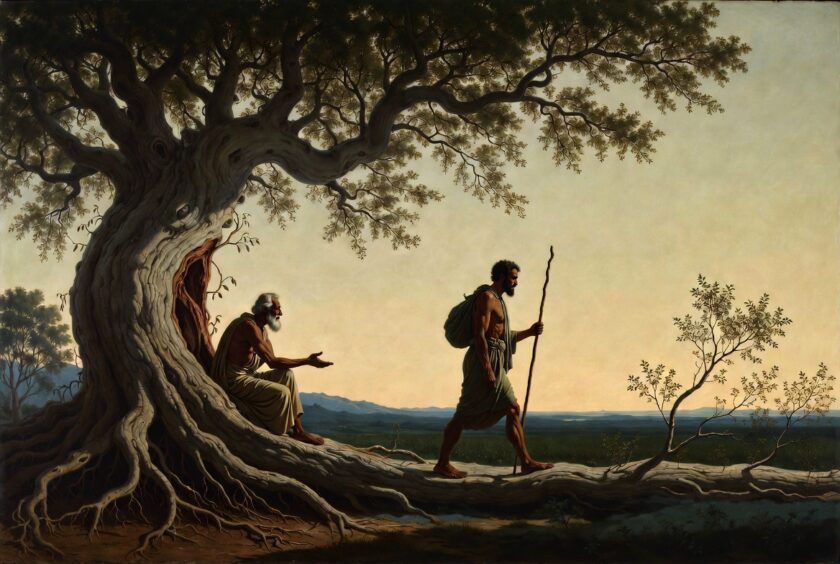
Genesis 27 ended with Jacob being sent away under the threat of violence. Genesis 28 begins by revealing that his departure carries another purpose. Isaac calls Jacob back into his presence, blesses him knowingly, and gives him a direction. Jacob is leaving the household not only to escape Esau, but to seek the relationship through which the inherited promise can continue.
The contrast with the previous chapter is immediate. Isaac no longer asks, “Who are you?” There is no disguise, sensory conflict, or uncertainty. He sees Jacob as Jacob and deliberately says, “May God Almighty bless you and make you fruitful and multiply you, so that you may become a multitude of people.”
The first blessing was transmitted under false recognition. This one is spoken with full recognition.
Isaac then reaches farther back into the family’s history: “May He also give the blessing of Abraham to you and your descendants with you.” What had passed from Abraham to Isaac is now consciously placed upon Jacob. The inheritance is no longer expressed only as rank within the household or authority over his brother. It is tied to fertility, descendants, land, and the continuation of a living lineage.
Biological inheritance also requires more than successful transmission. Genetic information may pass intact from one generation to another, but continuity depends upon whether its bearer survives, reproduces, and forms a bond capable of carrying that inheritance forward. What is received must enter conditions in which it can continue living.
This gives Isaac’s command concerning marriage its biological weight. “You shall not take a wife from the daughters of Canaan.” Jacob is sent toward his mother’s family, back toward the household from which Rebekah herself had been chosen for Isaac. Genesis 24 showed that the continuation of the lineage required discernment, movement, recognition, and a compatible bond. Genesis 28 now returns to that same reproductive path, but Jacob must travel it himself.
The command does not mean that a lineage remains biologically unchanged through reproduction; every child receives a new combination of inherited material. Continuity is preserved not by making an exact copy, but by carrying a recognizable inheritance through change. Jacob must join with another life, produce descendants, and extend the family into forms that do not yet exist.
Only then does Isaac send him away.
The blessing has already crossed the threshold. Now it must move beyond the household, survive displacement, form a new bond, and become many.
What was transmitted in confusion is affirmed in clarity.
What was inherited is given direction.
And the next bearer of the promise begins his journey.