
Genesis 22:1–2 (AMP)
1 Now after these things God tested Abraham, and said to him, “Abraham!” And he said, “Here I am.”
2 God said, “Take now your son, your only son [of promise], whom you love, Isaac, and go to the region of Moriah, and offer him there as a burnt offering on one of the mountains of which I will tell you.”
⸻
🔬 Metabolic Commentary — Stress Without Resolution
A son has already been given after years of delay.
Abraham had lived under a promise that his line would continue, and Isaac is the child through whom that promise has finally taken shape. He is not one child among many. He is the continuation of everything that has been spoken, delayed, protected, and fulfilled.
The call comes after that fulfillment.
No famine.
No enemy.
No visible instability.
“God tested Abraham.”
The condition is named before it is understood. The word arrives first — tested — but nothing yet explains what the test will require. What follows is not correction, not rescue, not provision. It is exposure.
“Abraham!”
The response is immediate.
“Here I am.”
Attention does not break. The response does not scatter. The line remains open.
Then the directive unfolds.
“Take now your son… your only son… whom you love… Isaac.”
The language narrows deliberately.
Not just “your son.”
“Your only son.”
“Whom you love.”
“Isaac.”
Each phrase concentrates the weight. The command does not rush. It layers. The text makes sure the reader understands what is being placed under demand.
And then:
“Offer him.”
No explanation follows.
No reason is given.
No outcome is described.
No alternative is provided.
The command stands alone — complete, irreversible, and unresolved.
This is not ordinary stress.
A father is told to offer his son.
The same voice that gave the promise now speaks a command that appears to undo it. The body is built to protect what it loves. Instinct moves to shield and escape. Here, that instinct is brought into direct conflict with what has been heard.
There is no category that resolves this cleanly.
What has been given is now placed under demand.
What has been promised is brought into question.
What has been loved is now at risk of destruction by the very hand commanded to protect it.
No instinct offers an exit.
No prior word from the same voice clarifies it.
The contradiction does not dissolve. It settles deeper.
Only then does the body register what is required.
In the body, stress is not defined only by intensity, but by whether it can be completed. Most stress follows a cycle: signal, response, discharge, return. A threat appears. The body mobilizes. Action resolves the threat. Regulation restores balance.
Here, that cycle is interrupted at the beginning.
Signal is given.
Response is required.
But no discharge is available.
There is no enemy to confront.
No path of escape.
No action that resolves the tension.
The body is left in sustained activation.
Under unresolved stress, the body does not power down. It stays ready. Energy is held in reserve. Action is prepared, but not completed.
That is what has been introduced here.
Not chaos.
Not collapse.
But pressure without release.
“Go to the region of Moriah… on one of the mountains of which I will tell you.”
Even the location is withheld.
Direction is given, but not completed. Movement is required, but the endpoint remains undefined. The path itself becomes part of the load. Abraham is not handed an answer. He is handed a direction.
Nothing in the passage resolves what has been spoken.
The promise has not been withdrawn.
The son still stands before him.
The command does not explain itself.
All three remain in tension.
And that tension is not removed.
It is carried.
The call has been given.
The weight has been placed.
No answer is supplied.
Only movement remains.
Image prompt:
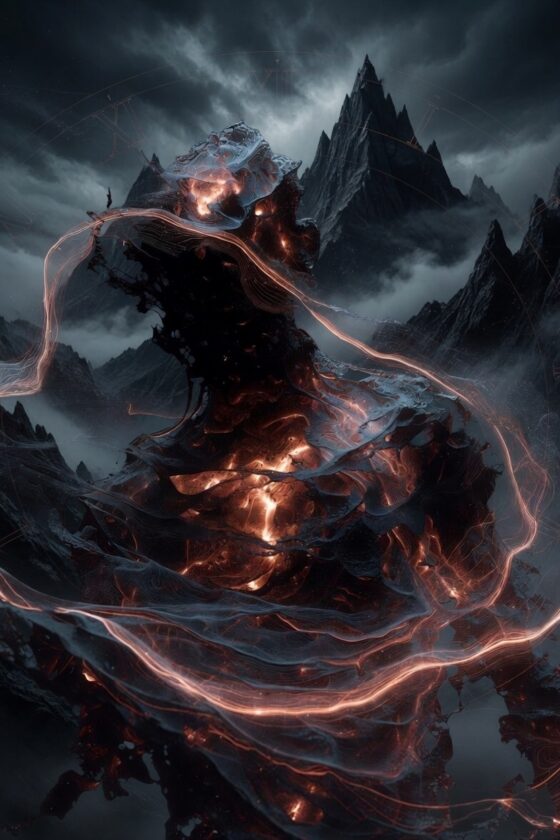
"An abstract biological scene representing sustained stress without release, featuring a dark human silhouette dissolving into layered waves of energy. Glowing amber and deep red currents circulate endlessly through the body without escaping, forming closed loops. The chest and head glow brightest, showing pressure buildup. No outward motion, only internal circulation. Background is a vast dark void with faint circular patterns like incomplete cycles. Subtle clock-like arcs fade into the distance, suggesting time passing without resolution. Style is cinematic, high contrast, soft organic textures, no text, no labels."
Genesis 22:3–5 (AMP)
3 So Abraham got up early in the morning, saddled his donkey, and took two of his young men with him and Isaac his son; and he split the wood for the burnt offering, and set out and went to the place of which God had told him. 4 On the third day Abraham looked up and saw the place in the distance. 5 Abraham said to his servants, “Stay here with the donkey; the young man and I will go over there and worship, and we will come again to you.”

⸻
🔬 Metabolic Commentary — Learned Response Under Sustained Load
The command has already been given.
A father has been told to offer the son through whom every promise has taken shape. No explanation. No outcome. Only unresolved tension as movement begins.
“So Abraham got up early in the morning.”
There is no delay.
He saddles the donkey.
He takes two young men.
He takes Isaac his son.
He splits the wood.
Each step is ordinary. Deliberate. Sequential.
Routine holds.
Under pressure, coordination often fractures—tasks scatter, attention narrows, movement becomes uneven. But here the pattern remains intact. The same actions proceed in the same order.
“On the third day…”
Time extends the load.
This is no longer a passing surge. The strain travels with him—step after step, night after night. Sleep thins. Tension accumulates. Still the body continues forward without release.
“Abraham looked up and saw the place in the distance.”
The destination appears while the tension is still fully active.
What has been carried internally now stands ahead, fixed and unavoidable.
Then the movement narrows.
“Stay here with the donkey…”
The young men remain behind.
What was shared becomes concentrated.
What was buffered becomes direct.
Now only father and son continue.
And then the statement:
“We will go… and we will return.”
The words hang in the air.
Nothing has changed.
The command remains.
The path has only narrowed.
Yet the forward orientation holds.
This is not relief.
It is not resolution.
It is movement that does not break when resolution is withheld.
So the journey continues.
The distance closes.
The support thins.
The pressure remains.
But the movement does not break.
What began as a command without resolution is now carried forward through time without reaction.
And that reveals something new:
The response is no longer instinct.
It has been formed.
Genesis 22:6–8 (AMP)
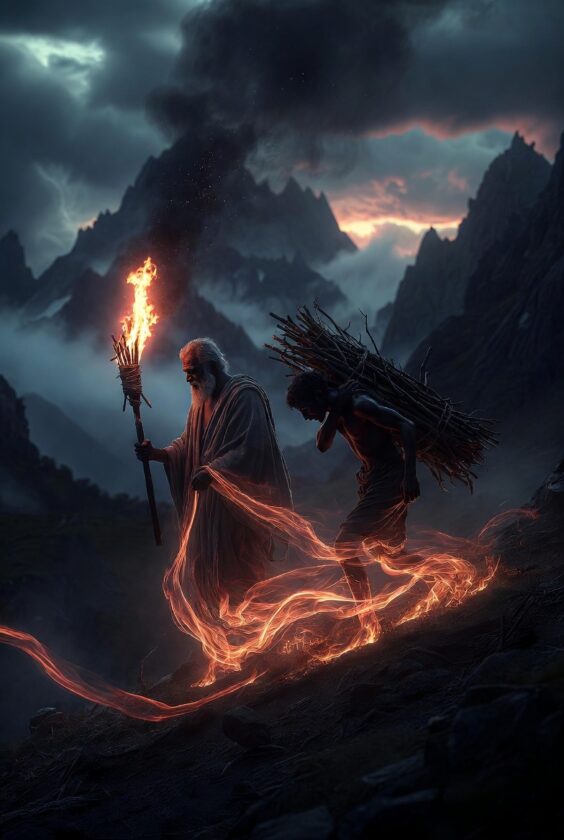
6 Then Abraham took the wood for the burnt offering and laid it on Isaac his son, and he took the fire in his own hand and the knife; and the two of them walked on together.
7 Isaac spoke to Abraham his father and said, “My father!” And he said, “Here I am, my son.” And Isaac said, “Look, the fire and the wood, but where is the lamb for the burnt offering?”
8 Abraham said, “God will provide for Himself the lamb for the burnt offering, my son.” So the two of them walked on together.
⸻
🔬 Metabolic Commentary — Shared Tension Without Resolution
The journey has already stretched across days, yet the direction remains unspoken.
Now the weight can be seen.
“Abraham took the wood… and laid it on Isaac his son.”
The weight shifts.
The wood settles onto Isaac’s shoulders—rough, unshaped, still carrying the scent of the mountain. It presses into bone with each step. What had been carried in silence now takes form. It is no longer held within the father alone.
And Isaac bears it.
“And he took the fire… and the knife.”
The elements are divided.
The son carries the structure.
The father carries the means.
Fire and knife—once used, they do not return things as they were. They remain in Abraham’s hand.
“So the two of them walked on together.”
The line returns.
Nothing resolves.
Nothing is explained.
They walk.
The path continues as it has—step after step—only now the weight is shared.
Then Isaac speaks.
“My father…”
“Here I am, my son.”
The same readiness answers.
“Look—the fire… and the wood…”
Everything is present.
Everything that should be seen—can be seen.
“But where is the lamb?”
The question lands.
The fire is there.
The wood is there.
The path is set.
And something—
is not.
The body can carry pressure without naming it—until the mind gathers what is present and the pieces refuse to settle. Something in the chest tightens. Breathing shortens. Attention narrows toward what is missing.
The body prepares for a resolution that does not come.
And once seen, it does not leave.
The question does not remain between them alone.
It passes outward.
The same elements now stand before the one reading.
The fire.
The wood.
The ascent.
The mind begins to complete what has not been said.
And what it completes—
cannot be undone.
The question is asked once.
But it continues.
Quietly.
Internally.
With increasing weight.
“Where is the lamb?”
Abraham answers:
“God will provide for Himself the lamb…”
No explanation is added.
No timing is given.
Nothing is resolved.
The answer does not remove the question.
But the movement does not break.
The pressure remains.
The contradiction remains.
And still—
they walk.
“So the two of them walked on together.”
The line returns again.
The father continues forward.
The son remains beside him.
The weight is carried—
not removed,
not explained,
but held.
And now—
it is no longer carried by one.
It has been placed
on these shoulders too.
Genesis 22:9–10 (AMP)
9 Then they came to the place of which God had told him; and Abraham built an altar there and arranged the wood, and bound Isaac his son and laid him on the altar, on top of the wood. 10 Abraham stretched out his hand and took the knife to kill his son.

⸻
🔬 Metabolic Commentary — The Edge Without Release
They arrive.
The carrying is over.
“Then they came to the place…”
No more distance remains to absorb the pressure.
Only the act remains.
“Abraham built an altar there and arranged the wood…”
Piece by piece the structure forms.
Wood laid.
Position fixed.
Nothing left undefined.
The body anticipates what the structure requires before it is spoken.
“He bound Isaac his son…”
Hands on skin.
Rope drawn tight across chest and limbs.
Pressure. Adjustment. Securing.
Every protective reflex fires.
Muscles resist.
Breath destabilizes.
The body prepares to interrupt.
Yet the binding completes.
No break.
No recoil.
“And laid him on the altar…”
The wood once carried now receives him.
Still.
Exposed.
Placed within what has been built around him.
Nothing remains unprepared.
“Abraham stretched out his hand…”
The motion begins.
Slow enough to feel.
Under acute threat, the body normally accelerates—fast movement to discharge the signal and end the strain.
This does not accelerate.
The pressure remains.
It thickens.
“And took the knife…”
Cold.
Weighted.
Certain.
Every protective circuit is active.
Heart rate elevated.
Vision narrowed.
Attention fixed.
The body is fully prepared to stop what is happening.
And still—
the sequence does not break.
This is the biology of sustained override:
protective reflex remains active,
yet action continues.
Not because the stress is absent.
Not because instinct is quiet.
But because the movement does not yield to it.
The hand rises.
The breath shortens—
not only in the man,
but in the one who watches.
Attention locks.
The moment stretches.
No release appears.
The knife—
is raised.
⸻
Genesis 22:11–14 (AMP)
11 But the Angel of the LORD called to him from heaven and said, “Abraham, Abraham!” And he answered, “Here I am.”
12 He said, “Do not reach out your hand against the boy, and do nothing to him; for now I know that you fear God, since you have not withheld your son, your only son, from Me.”
13 Then Abraham looked up and glanced around, and behold, behind him was a ram caught in the thicket by his horns; and Abraham went and took the ram and offered it up as a burnt offering in the place of his son.
14 So Abraham named that place The LORD Will Provide; as it is said to this day, “On the mountain of the LORD it will be provided.”

⸻
🔬 Metabolic Commentary — Interruption and Completion
The knife is raised.
And then—
“Abraham, Abraham!”
The call cuts in from outside.
Not from thought.
Not from effort.
Not from the body itself.
The sequence stops.
“Do not reach out your hand…”
The action that drove every step is halted in a single breath.
At this peak the body is locked:
heart driving hard,
breath shallow,
vision narrowed to a blade’s edge.
Every protective instinct active at once.
Cortisol has ridden the entire sequence—released at the first signal, held across days and distance, keeping energy available, sharpening attention, delaying recovery.
It never fell.
Under that sustained signal, time compresses.
Everything else fades.
The mind circles the same unresolved point.
Now—
the signal changes.
The threat is removed.
And the body answers immediately.
Muscles release.
Breath drops deep into the belly.
Circulation opens.
Cortisol begins its fall.
This is the completion of a stress cycle that could not resolve internally.
Relief arrives through interruption.
“Now I know that you fear God…”
Nothing new has been added.
What has been shown is already complete.
Attention widens.
“Abraham looked up…”
The tunnel opens.
And there—already present, only now visible—
a ram caught in the thicket.
Not created in this moment.
Not introduced after the fact.
Already there.
Only now accessible.
“Abraham… offered it up in place of his son.”
The structure remains.
The altar stands.
The fire is used.
The action completes—
not removed,
not abandoned,
but redirected.
So the place is named:
“The LORD Will Provide.”
Not before the pressure.
Not during the strain.
But after the body has been carried
all the way to its limit—
and the release reveals
what was already there.
Genesis 22:15–18 (AMP)
15 The Angel of the LORD called to Abraham from heaven a second time,
16 and said, “By Myself [on the basis of who I am] I have sworn [an oath], declares the LORD, that since you have done this thing and have not withheld your son, your only son [of promise],
17 indeed I will greatly bless you, and I will greatly multiply your descendants like the stars of the heavens and like the sand on the seashore; and your seed shall possess the gate of their enemies [as conquerors].
18 Through your seed all the nations of the earth shall be blessed, because you have heard and obeyed My voice.”

⸻
🔬 Metabolic Commentary — Transmission at the Threshold
The interruption has already come, the body has released, and the immediate demand has passed, but what remains is not the threat itself—it is the shape it has left behind.
“Since you have done this thing…”
Done—not intended, not explained, not believed, but completed.
Completion does not erase the moment; it fixes it. What was carried to the limit now exists as something that has been fully traversed, not imagined or avoided, and the body does not forget this kind of passage. It retains it not only in memory, but in posture, in breath, and in the way tension is held and released when pressure begins to rise again.
Under sustained pressure, the body adapts. Hormonal signaling shifts, stress pathways are reinforced, and regulatory patterns are altered in ways that persist beyond the moment itself. These changes do not remain abstract—they settle into movement and load, so that shoulders that once carried the wood learn how to remain steady under weight they once could not have borne.
“Indeed I will greatly bless you…”
The movement widens here, because what has been demonstrated in one body is now spoken over many—not as something automatically transferred, but as something that can be encountered again.
“I will greatly multiply your descendants…”
Multiplication is not only number; it is exposure. Others will enter similar conditions—uncertainty, delay, pressure without resolution—and the stress itself will not change. What may change is what stands within it.
“Your seed shall possess the gate of their enemies…”
The boundary comes into view. A gate is the place where pressure gathers, where force meets what has been formed, and where stability is either broken or proven. The covenant does not remove that pressure; it defines where the pattern is held.
“Enemies” are not simply those outside. They are whatever presses hard enough to break what has been formed.
To possess the gate is not to eliminate opposition, but to remain ordered while pressure is applied.
Sustained pressure does not pass through a body without leaving a mark. What is carried begins to change what can be carried again. What once overwhelmed can be endured longer, and what once scattered the body can begin to hold—not as a guarantee, and not as a fixed inheritance, but as something shaped in muscle, in breath, and in the quiet adjustments a body makes to remain under load.
“And through your seed…”
The widening completes. What began in one body under tension becomes something others can step into, not through instruction alone, but through encounter. Isaac has already walked within it—he has seen the elements, felt the narrowing, and remained within the same unresolved field without seeing the pattern break.
That is how it is carried—not imposed, not explained, but witnessed.
“Because you have heard and obeyed My voice.”
The sequence closes: signal received, pressure applied, response carried, completion reached.
And something remains.
The mountain remains. The path remains. The moment can return. The knife can be raised again.
But now it has been shown: a body can be carried all the way to the limit—and not break.
Genesis 22:19–24 (AMP)
19 So Abraham returned to his servants, and they arose and went together to Beersheba; and Abraham lived at Beersheba.
20 Now after these things it was told Abraham, “Milcah has also borne children to your brother Nahor:
21 Uz his firstborn and Buz his brother and Kemuel the father of Aram,
22 and Chesed and Hazo and Pildash and Jidlaph and Bethuel.”
23 Bethuel became the father of Rebekah. These eight Milcah bore to Nahor, Abraham’s brother.
24 His concubine, whose name was Reumah, also bore Tebah and Gaham and Tahash and Maacah.
⸻
🔬 Metabolic Commentary — Consolidation and Transmission
The mountain is behind him, but the body does not return unchanged.
“So Abraham returned…”
Return does not mean reversal. The path closes, but what passed through it does not disappear; it settles quietly into how the body now holds tension and moves forward.
“And they arose and went together…”
What endured under pressure remains intact after it. No fracture is described, no separation follows. The relationship that moved toward the threshold returns from it still joined.
This is where the difference becomes visible—not between stress and no stress, but between stress that completes and stress that does not.
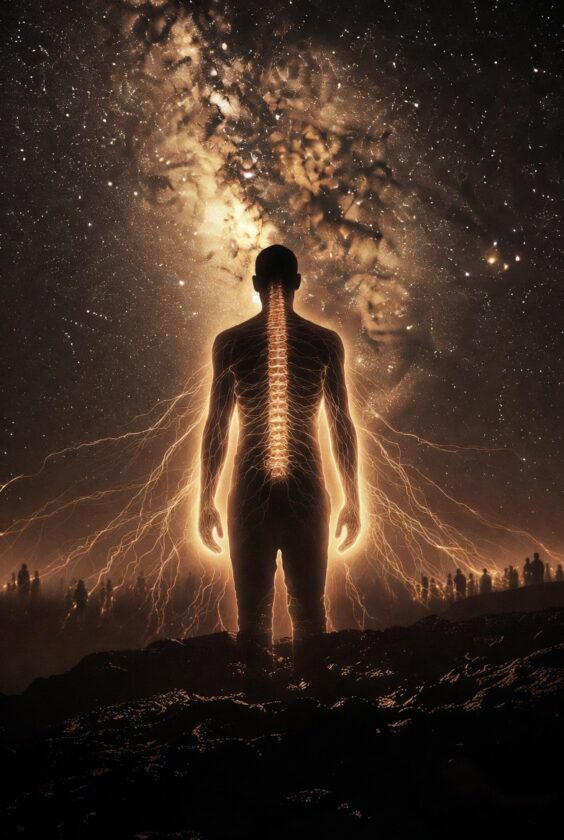
In the body, stress follows a sequence. A signal appears, the hypothalamus activates, the pituitary responds, and the adrenal glands release cortisol. Heart rate rises, energy mobilizes, attention narrows. The body prepares for action. This is not damage; it is correct response under load.
But that is only the beginning.
If the sequence completes, cortisol falls. The nervous system downshifts, and the body restores baseline through natural feedback. The hippocampus places the event in time, marking it as something that has ended. The prefrontal cortex regains control, and response becomes chosen again rather than driven. The experience becomes bounded—remembered, but not continually relived. The breath lengthens. The shoulders release. The body knows the moment has passed.
If the sequence does not complete, the pattern changes. Cortisol remains elevated or rises too easily. The amygdala continues to signal threat, memory fragments or intrudes, and the body behaves as though the event is still present because it has not been fully placed.
That difference is not defined by intensity. It is defined by completion.
“So Abraham returned…”
Nothing in the text suggests fragmentation. Movement resumes. Coordination holds. The return reads as a sequence that has reached its end.
“And Abraham lived at Beersheba.”
Life continues. There is no repetition of the event, no withdrawal from ordinary rhythm. What occurred remains real, but it does not govern every moment that follows.
Then the text shifts.
“Now after these things…”
A genealogy.
Names accumulate without explanation, yet their placement is exact.
“Bethuel became the father of Rebekah.”
The name passes quietly, but this is the woman who will later become Isaac’s wife—the one through whom the line continues. The next stage is already present. What was carried through pressure now has somewhere to go.
In living bodies, what moves forward is not memory in words but pattern in flesh—how pressure is met, how stability is held in the body, how relationships remain joined even after the blade was lifted. These things are not explained to the next generation. They are lived.
What is repeated becomes familiar. What is familiar becomes easier to carry. Over time, what once required endurance begins to hold with less strain.
That is what begins here.
The event on the mountain is not repeated. It is carried.
The next generation does not receive an explanation. It receives a life that continued, a relationship that held, a path that did not break.
“And through your seed…”
The earlier promise now has direction—not in the moment of crisis, but in what follows after it.
Life resumes. The line extends. The next threshold approaches unseen.
And what was formed under pressure does not remain confined to a single moment.
It moves forward—
to be encountered again.
Because in living bodies, pressure is not what defines the future.
Completion is.
When stress is carried without breaking and allowed to resolve, it does not remain as disturbance. It becomes structure. The response that held under load becomes easier to access the next time—requiring less effort, settling more quickly, holding more steadily.
What was once survival becomes pattern.
What becomes pattern becomes stability.
What stabilizes can be transmitted.
This is how alignment moves forward.
Not by explanation.
Not by memory alone.
But by what has been formed and can be carried without fracture.
The mountain is not repeated.
But what was formed there is.
And it passes quietly—
into the next life that will bear it.