
Genesis 27:1–4 (AMP)
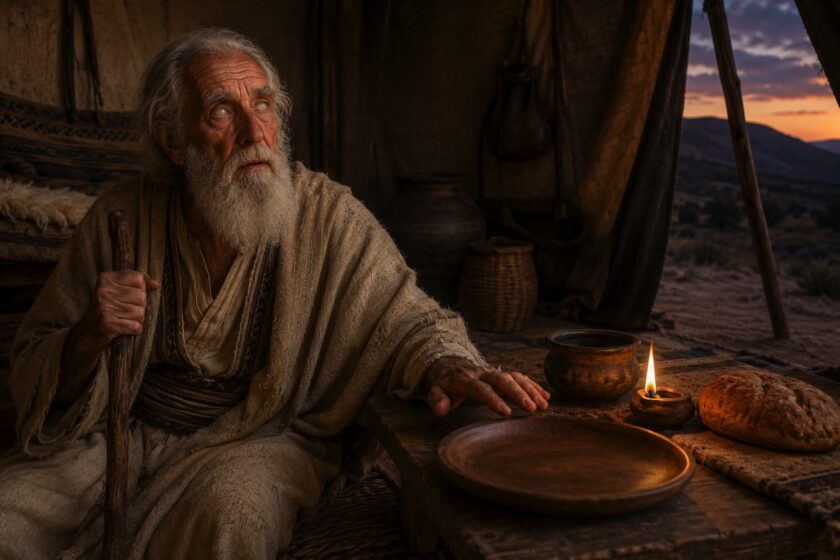
1 When Isaac was old and his eyes were too dim to see, he called his elder son Esau and said to him, “My son.” And he answered, “Here I am.”
2 Isaac said, “See here, I am old. I do not know when I may die.
3 So now, please take your hunting gear, your quiver and your bow, and go out into the field and hunt game for me;
4 and prepare for me savory food such as I love, and bring it to me so that I may eat; then my soul may bless you before I die.”
⸻
🔬 Metabolic Commentary — Recognition Under Sensory Decline
Genesis 26 ended with a quiet warning. Esau's marriages brought grief into Isaac and Rebekah's household, revealing that continuity remained vulnerable even after access to the covenant had been preserved. Now the narrative moves to a different question. The inheritance still exists, but it must be entrusted to the next generation. Before that can happen, Isaac must recognize the one standing before him.
The opening verse immediately introduces the central constraint.
"His eyes were too dim to see."
Vision is the body's fastest means of identifying the world around it. It allows us to recognize faces, distinguish friend from stranger, judge distance, and respond before danger or opportunity reaches us. As eyesight declines with age, none of those responsibilities disappear. The need to recognize reality remains, even when perception becomes more difficult.
Living bodies are remarkably resilient in this regard. When one sensory pathway weakens, the brain does not simply surrender. It begins relying more heavily upon the information that remains. Touch becomes more deliberate. Familiar voices carry greater weight. Smell, taste, memory, and expectation all contribute to recognition. Rather than trusting a single signal, the brain integrates many streams of evidence into one decision. Under ordinary circumstances, this allows accurate judgment even when one sense has faded.
Isaac's actions reflect that quiet adaptation. He does not bless impulsively. He first calls Esau near. He asks him to hunt game and prepare "savory food such as I love." These are not arbitrary requests. They arise from a lifetime of shared experience. The familiar meal becomes part of the process by which Isaac prepares to recognize and bless his son. Appetite here is not merely indulgence; it is woven into memory, relationship, and expectation.
The text also places the blessing beside mortality.
"I do not know when I may die."
The urgency is understandable. Isaac is not attempting to control the future indefinitely. He recognizes that every generation eventually reaches the point where what has been carried must be entrusted to another. The covenant cannot remain with its present steward forever. Transmission has become the task before him.
Yet the conditions for that transfer have quietly changed. Vision has already diminished. The responsibility has not.
Nothing deceptive has happened yet. No disguise has been prepared. No words have been twisted. The chapter simply allows us to see the environment in which the coming decision will unfold. One avenue of recognition has narrowed, and the remaining senses will soon bear greater responsibility than before.
This is often how error enters living bodies. Failure rarely begins because every signal disappears at once. More often, one source of information grows weaker, and the remaining cues carry increasing weight. When those cues still correspond to reality, judgment remains reliable. When they are carefully manipulated, confidence may remain high even as recognition quietly drifts away from the truth.
The blessing has not yet been spoken.
The inheritance has not yet changed hands.
Only the conditions of recognition have been established.
And before the future can be entrusted, the one who bears it must first be known.
Genesis 27:5–17 (AMP)
5 Now Rebekah was listening when Isaac spoke to Esau his son. And when Esau went to the field to hunt for game to bring home,
6 So Rebekah spoke to Jacob her son, saying, “Indeed I heard your father speak to Esau your brother, saying,
7 ‘Bring me game and prepare savory food for me, that I may eat it and bless you in the presence of the LORD before my death.’
8 Now therefore, my son, listen carefully to me and do exactly as I command you.
9 Go now to the flock and bring me two choice young goats, and I will make them into delicious food for your father, such as he loves.
10 Then you shall bring it to your father to eat, so that he may bless you before his death.”
11 Jacob said to Rebekah his mother, “Listen carefully, Esau my brother is a hairy man and I am a smooth-skinned man.
12 Perhaps my father will feel me, and I will be seen by him as a cheat, and I will bring his curse on me and not a blessing.”
13 But his mother said to him, “Your curse be on me, my son; only obey me, and go, get them for me.”
14 So he went and got them and brought them to his mother; and his mother prepared delicious food, such as his father loved.
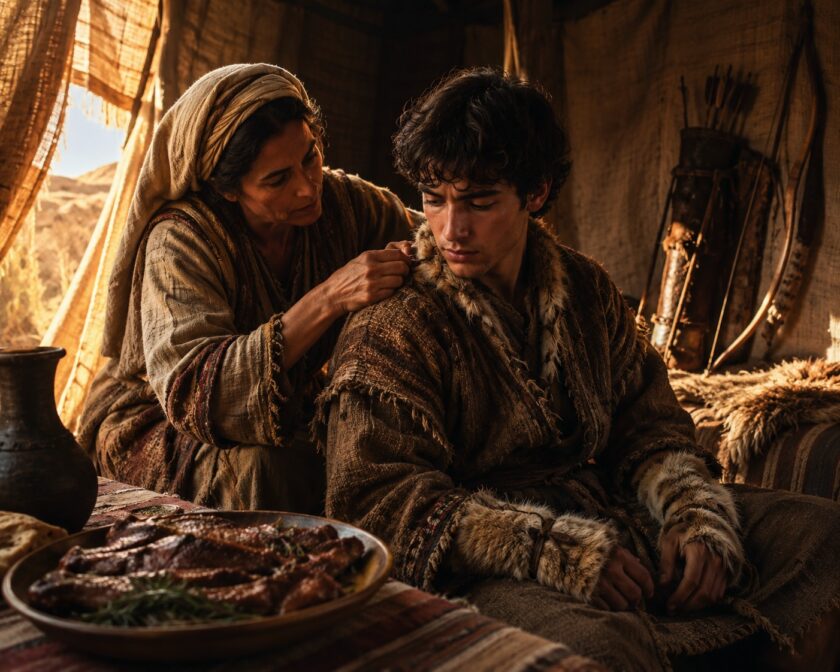
15 Then Rebekah took the best clothes of Esau her elder son, which were with her in the house, and put them on Jacob her younger son.
16 And she put the skins of the young goats on his hands and on the smooth part of his neck.
17 Then she gave the delicious food and the bread, which she had prepared, to her son Jacob.
⸻
🔬 Metabolic Commentary — Multisensory Mimicry
Isaac has spoken.
Esau has gone into the field.
But one other person has heard every word.
Rebekah.
From that moment forward, the movement of the household changes. What had been Isaac's intention now becomes Rebekah's decision.
Recognition is shaped not only by the signals we receive, but by the internal models we construct from them. When confidence in direct perception weakens, living systems lean more heavily on prediction. This capacity is essential, yet models that drift beyond continual correction can redirect inheritance itself.
Rebekah overhears Isaac's words to Esau. In that moment, the household no longer shares the same picture of reality. Isaac's dimmed eyes can no longer calibrate the present; Rebekah's ears receive information that Isaac himself cannot verify. She does not pause to test her understanding, consult her husband, or allow events to unfold. Instead, she rapidly constructs an internal model: if nothing intervenes, Esau will receive the blessing, and the family's future will harden along that path. From that prediction every subsequent action flows—choice goats, savory stew, Esau's garments, goat skins upon Jacob's hands—each detail carefully arranged to satisfy the model she has already accepted.
Yet Rebekah's prediction does not arise in isolation. Years earlier, God declared that "the older shall serve the younger" (Genesis 25:23), giving her genuine reason to expect Jacob's future prominence. Her expectation rests upon a true revelation, not mere imagination. But another memory also shapes her response. Abraham repeatedly preserved his household through deception. Isaac repeated the same strategy before Abimelech. Over time, concealment had become a learned response under pressure. Rebekah therefore draws upon both the remembered promise of God and the practiced habits of her family. One remembers what God had said. The other remembers what the household had learned to do. Even accurate knowledge, however, can become distorted when prediction outruns patient recognition. Trusting the destination is not the same as assuming responsibility for the route.
This is anticipatory control. The brain is not a passive receiver of information but an active prediction engine. Modern neuroscience describes perception not as a passive recording of reality, but as a continual process of prediction and correction. Visual cortex, auditory pathways, and even the body's awareness of hunger, pain, or threat are continually compared against internal models built from memory and expectation. Perception is not merely received; it is continually refined through prediction error. As incoming signals become weaker or less reliable—as with Isaac's failing vision—the nervous system naturally leans more heavily upon its internal expectations. Emotion, urgency, and prior commitments can strengthen that tendency until the model begins directing behavior rather than simply interpreting reality.
Biologically, this predictive capacity is ancient and often beneficial. The cerebellum anticipates limb position before movement. The immune system prepares for familiar pathogens from remembered encounters. Even the gut-brain axis begins preparing the body for nutrients before food has fully arrived. Healthy prediction remains accountable to reality through continual correction. Once correction is bypassed, prediction no longer serves reality—it begins constructing it instead.
Inside the tent, Rebekah continues her work. She dresses Jacob in Esau's garments, fastens the goatskins around his hands and neck, and places the prepared meal into his arms. One by one, each outward signal is arranged to support the same conclusion before Isaac has spoken another word.
Rebekah's plan is not merely deception; deception is the instrument. The deeper mechanism is predictive override: acting according to what the model insists must happen rather than remaining open to what the present still permits.
The household now begins coordinating itself around incomplete information. Isaac's uncertainty, Rebekah's forecast, and Jacob's compliance each compound the distortion. What begins as a single sensory limitation cascades into coordinated action capable of redirecting the family's future. The blessing, once intended as recognition grounded in embodied presence, now risks being transferred through an increasingly elaborate simulation.
The narrative is moving from valuation in Genesis 25, through maintained access in Genesis 26, into recognition under uncertainty in Genesis 27.
The question is no longer simply who receives the birthright, but what becomes of a household when its internal models drift beyond continual correction.
Prediction begins to shape inheritance.
Inheritance, once released, cannot easily be recalled.
The blessing remains genuine.
The recognition does not.
And so the blessing, once anchored in embodied recognition, begins its journey along a simulated path.
Genesis 27:18–29 (AMP)
18 He went to his father and said, “My father.”
“Yes, my son,” he answered. “Who is it?”
19 Jacob said to his father, “I am Esau your firstborn. I have done as you told me. Please sit up and eat some of my game, so that you may give me your blessing.”
20 Isaac asked his son, “How did you find it so quickly, my son?”
“The Lord your God gave me success,” he replied.
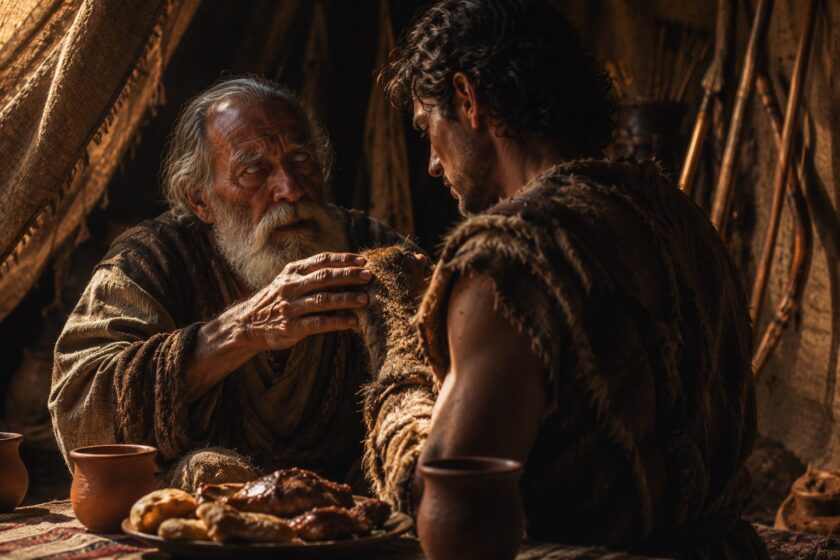
21 Then Isaac said to Jacob, “Come near so I can touch you, my son, to know whether you really are my son Esau or not.”
22 Jacob went close to his father Isaac, who touched him and said, “The voice is the voice of Jacob, but the hands are the hands of Esau.”
23 He did not recognize him, for his hands were hairy like those of his brother Esau; so he proceeded to bless him.
24 “Are you really my son Esau?” he asked.
“I am,” he replied.
25 Then he said, “My son, bring me some of your game to eat, so that I may give you my blessing.”
Jacob brought it to him and he ate; and he brought some wine and he drank.
26 Then his father Isaac said to him, “Come here, my son, and kiss me.”
27 So he went to him and kissed him. When Isaac caught the smell of his clothes, he blessed him and said:
“Ah, the smell of my son
is like the smell of a field
that the Lord has blessed.
May God give you heaven's dew
and earth's richness—
an abundance of grain and new wine.
May nations serve you
and peoples bow down to you.
Be lord over your brothers,
and may the sons of your mother bow down to you.
May those who curse you be cursed
and those who bless you be blessed.”
⸻
🔬 Metabolic Commentary — Recognition at the Decision Threshold
Following his mother's instructions, Jacob enters Isaac's tent disguised as Esau, carrying the savory meal his father had requested. Yet before the blessing can be spoken, Isaac hesitates. "Who is it?" (v.18) Although the meal has arrived exactly as expected, something within Isaac's perception remains unsettled. The recognition process has begun, but the evidence has not yet converged.
Isaac immediately begins testing the signals before him. "Come near so I can touch you, my son, to know whether you really are my son Esau or not." (v.21) His eyesight has failed, forcing him to depend upon every remaining avenue of recognition. When Jacob approaches, Isaac listens carefully and concludes, "The voice is the voice of Jacob, but the hands are the hands of Esau." (v.22) One sense raises suspicion while another argues the opposite. Rather than trusting a single observation, Isaac continues gathering evidence—touch, voice, the taste of the meal, the smell of the garments—allowing multiple streams of information to compete before reaching a conclusion.
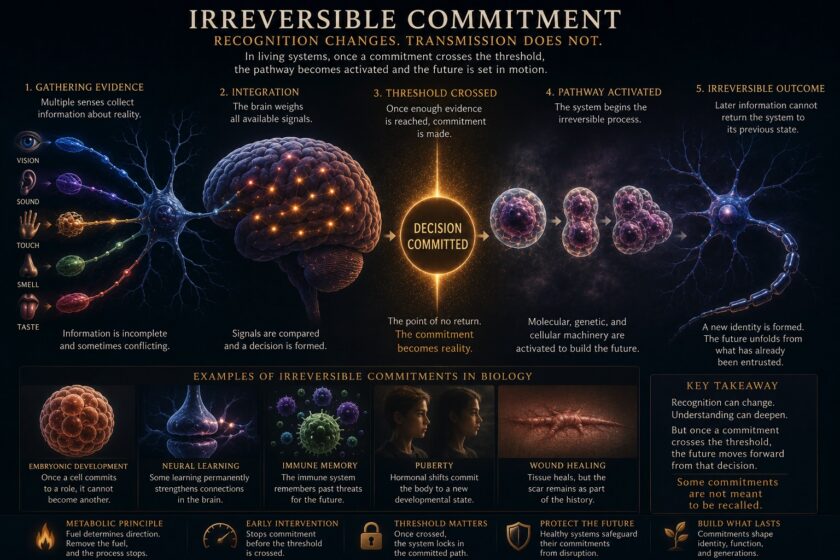
Living organisms rarely act with perfect certainty. The nervous system constantly integrates sight, sound, touch, smell, taste, memory, and expectation into one working picture of reality.
Recognition is active discrimination. When one pathway weakens, as with Isaac's dimmed eyes, the body naturally weighs the remaining cues more heavily. Conflicting signals create hesitation. Only when the accumulated evidence crosses an internal decision threshold does action proceed, often while some uncertainty remains.
This is precisely what unfolds before Isaac. Jacob answers, "I am Esau your firstborn." (v.19) Yet Isaac is still not fully convinced, asking again, "Are you really my son Esau?" (v.24) Only after eating does Isaac make one final request: "Come here, my son, and kiss me." (v.26) As Jacob approaches, "he smelled the smell of his clothes, and he blessed him." (v.27) Voice, touch, taste, smell, memory, and expectation have finally converged. Individually, none of these signs proved Jacob's identity. Together they carried Isaac's recognition beyond the threshold of decision.
Once that threshold is crossed, the blessing follows. Genesis reminds us that some of life's most consequential acts occur under conditions of incomplete knowledge. Recognition rarely waits for absolute certainty. Life often requires action the moment confidence becomes sufficient to commit. The tragedy of this moment is not that the capacity for discernment failed, but that the very mechanisms created to faithfully identify reality were supplied with coordinated signals pointing toward a false conclusion. What follows is not merely a spoken blessing, but an irreversible transmission whose consequences extend far beyond the walls of Isaac's tent.
Genesis 27:30–40 (AMP)
30 Now as soon as Isaac had finished blessing Jacob, and Jacob had scarcely gone out from the presence of Isaac his father, Esau his brother came in from his hunting.
31 He also made savory food and brought it to his father; and he said to his father, “Let my father arise and eat of his son's game, so that you may bless me.”
32 Isaac his father said to him, “Who are you?”
And he answered, “I am your son, your firstborn, Esau.”
33 Then Isaac trembled violently, and said, “Who was he then that hunted game and brought it to me, so that I ate of everything before you came, and I blessed him? Yes, and he shall indeed be blessed.”
34 When Esau heard the words of his father, he cried out with an exceedingly great and bitter cry and said to his father, “Bless me, me also, O my father!”
35 And Isaac said, “Your brother came deceitfully and has taken away your blessing.”
36 Esau said, “Is he not rightly named Jacob? For he has supplanted me these two times. He took away my birthright, and now he has taken away my blessing!” Then he said, “Have you not reserved a blessing for me?”
37 But Isaac replied to Esau, “Listen carefully, I have made him your master, and I have given all his relatives to him as servants; and with grain and new wine I have sustained him. Now as for you then, what can I do, my son?”
38 Esau said to his father, “Have you only one blessing, my father? Bless me, me also, O my father.” So Esau lifted up his voice and wept.
39 Then Isaac his father answered him,
“Behold, away from the fertility of the earth shall be your dwelling,
And away from the dew of heaven from above.
40 By your sword you shall live,
And you shall serve your brother;
But when you become restless,
You will break his yoke from your neck.”
⸻
🔬 Metabolic Commentary — Irreversible Transmission
The blessing has barely been spoken when the true recipient arrives.
Jacob has scarcely left the tent before Esau enters carrying the meal Isaac had requested. The deception is uncovered almost immediately. Nothing about Isaac's recognition remains uncertain now.
"Who are you?"
"I am your son, your firstborn, Esau."
The realization strikes all at once.
"Then Isaac trembled violently."
The trembling is not simply surprise. It is the body's response when a deeply held model collapses beneath undeniable reality. Moments earlier, every remaining sensory pathway had converged toward a single conclusion. Now one unmistakable piece of evidence overturns the entire picture. The nervous system rapidly updates its understanding, but recognition has arrived after commitment rather than before it.
Living organisms constantly revise their internal models as new information appears. In many situations, those corrections immediately redirect behavior. Yet some decisions cross thresholds that cannot simply be undone. During embryonic development, cells progressively commit to becoming nerve, muscle, liver, or bone. Early in development, alternative futures remain possible. As differentiation proceeds, those possibilities narrow. Once a mature pathway has been established, later information can modify function but cannot return the tissue to its original state. The commitment itself becomes part of the organism's history.
Isaac recognizes something similar.
"I blessed him."
"Yes, and he shall indeed be blessed."
Recognition has changed.
The blessing has not.
Esau's cry is therefore one of the most painful in Genesis.
"Bless me, me also, O my father!"
He now understands what has happened, yet understanding alone cannot restore what has already been entrusted elsewhere. Earlier in the narrative, Esau treated the birthright as something exchangeable for immediate relief. Now the inheritance stands before him in its full weight, and for the first time he desires what cannot simply be reclaimed. The chapter that began with uncertain recognition now reveals the irreversible cost of delayed recognition. The birthright once undervalued has become the blessing now beyond recall, echoing the valuation established in Genesis 25.
Yet Isaac does not send Esau away empty.
He blesses him also.
The words are spoken.
But they are not the blessing Esau sought.
"Away from the fertility of the earth shall be your dwelling... By your sword you shall live... You shall serve your brother... But when you become restless, you will break his yoke from your neck."
The primary inheritance has already crossed to Jacob. What remains is a different future—one marked by hardship, conflict, service, and eventual release. The secondary blessing does not reopen the first commitment. It gives concrete shape to the world that now follows from it.
Genesis therefore carries the narrative beyond discovery into consequence.
Reality becomes clear.
The commitment remains.
The future divides.
Recognition can arrive after the threshold has been crossed.
It cannot always call the blessing back.
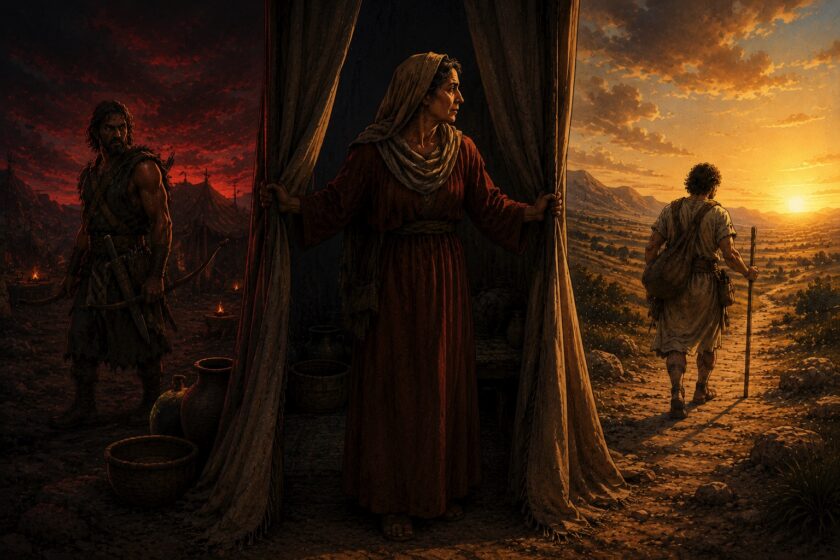
Genesis 27:41–46 (AMP)
41 So Esau hated Jacob because of the blessing with which his father had blessed him; and Esau said in his heart, “The days of mourning for my father are near; then I will kill my brother Jacob.”
42 Now when the words of her older son Esau were reported to Rebekah, she sent and called Jacob her younger son and said, “Listen carefully, your brother Esau is consoling himself concerning you by planning to kill you.
43 So now, my son, listen to me. Arise, flee at once to Haran, to my brother Laban!
44 Stay with him a while, until your brother’s fury subsides,
45 until your brother’s anger toward you subsides and he forgets what you did to him. Then I will send and bring you back from there. Why should I be deprived of you both in one day?”
46 Then Rebekah said to Isaac, “I am tired of living because of the daughters of Heth. If Jacob marries one of the daughters of Heth, as these women, one of the daughters of the land, what good will my life be to me?”
🔬 Metabolic Commentary
Recognition has finally settled, but the consequences cannot be recalled. Esau now knows what has happened, Isaac knows what has happened, and Jacob knows what has happened. The uncertainty that governed the earlier part of the chapter has disappeared, yet clarity alone does not restore peace. Once recognition has taken hold, an organism cannot return to the state that existed before. It must adapt to the conditions that now exist.
While uncertainty remained, the family continued living together despite growing tension. Once recognition became complete, the same household could no longer safely occupy the same space. Biological organisms frequently respond this way. When incompatible elements cannot be reconciled, they are separated before they destroy one another. Inflamed tissues are isolated. Damaged cells are removed. Conflicting neural activity is inhibited. Preservation sometimes requires distance rather than immediate repair.
Rebekah’s instruction to flee is therefore more than an escape. It is a protective compartmentalization. Jacob is removed from the environment where retaliation is most likely, allowing time for overwhelming emotion to subside before another encounter becomes possible. Separation is not presented as the ideal outcome, but as the means by which the future remains possible.
The chapter closes with Rebekah speaking of Jacob’s future marriage. What appears to be a change of subject quietly returns the narrative to the question of inheritance. The blessing must now continue beyond the immediate crisis into another generation. The family cannot remain frozen at the moment of deception. Life presses forward, carrying both its wounds and its promises into what comes next.
Genesis 27 therefore ends not with restored harmony, but with preserved continuity. Recognition has reached its conclusion. The blessing cannot be reclaimed. The conflict cannot remain unchecked. Life now reorganizes around the new reality. Separation is one form that reorganization takes so that life can continue.