
Genesis 31:1–16 (AMP)
1 Jacob heard that Laban’s sons were saying: “Jacob has taken away everything that was our father’s, and from what belonged to our father he has acquired all this wealth and honor.”
2 Jacob noticed [a change in] the attitude of Laban, and saw that it was not friendly toward him as before.
3 Then the Lord said to Jacob, “Return to the land of your fathers and to your people, and I will be with you.”
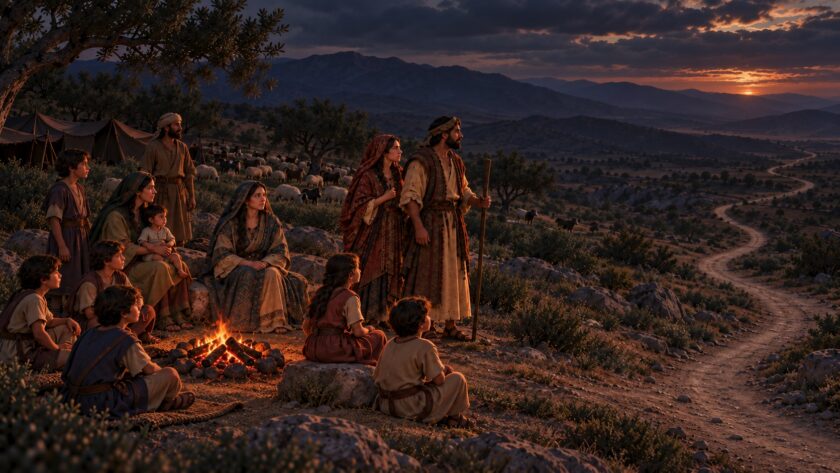
4 So Jacob sent and called Rachel and Leah to his flock in the field,
5 and he said to them, “I see [a change in] your father’s attitude, that he is not friendly toward me as [he was] before; but the God of my father [Isaac] has been with me.
6 You know that I have served your father with all my strength.
7 Yet your father has cheated me [as often as possible] and changed my wages ten times; but God did not allow him to hurt me.
8 If he said, ‘The speckled shall be your wages,’ then the entire flock gave birth to speckled [young]; and if he said, ‘The streaked shall be your wages,’ then the entire flock gave birth to streaked [young].
9 Thus God has taken away the flocks of your father and given them to me.
10 And it happened at the time when the flock conceived that I looked up and saw in a dream that the rams which mated [with the female goats] were streaked, speckled, and spotted.
11 And the Angel of God said to me in the dream, ‘Jacob.’ And I said, ‘Here I am.’
12 He said, ‘Look up and see, all the rams which are mating [with the flock] are streaked, speckled, and spotted; for I have seen all that Laban has been doing to you.
13 I am the God of Bethel, where you anointed the pillar, and where you made a vow to Me; now stand up, leave this land, and return to the land of your birth.’”
14 Rachel and Leah answered him, “Is there still any portion or inheritance for us in our father’s house?
15 Are we not counted by him as foreigners? For he sold us [to you in marriage], and has also entirely used up our purchase price.
16 Surely all the riches which God has taken from our father are ours and our children’s. Now then, whatever God has told you to do, do it.”
⸻
🔬 Metabolic Commentary — Early Warning and Shared Direction
The first voice in the chapter belongs to Laban’s sons. “Jacob has taken away everything that was our father’s.” They describe his increase as a loss from the household in which it developed. The abundance that closed Genesis 30 now stands under a competing claim of ownership. Before Jacob leaves, the people who remain are already speaking as though what he possesses belongs to their father.
These sons have a place in the arrangement. When Laban removed the marked animals from the flock Jacob would tend, he placed them in his sons’ care. They belong to the household that retained those animals while Jacob’s provision grew from what remained. Their accusation exposes a conflict over the meaning of that growth: Jacob has acquired the means to sustain his own household, while they describe those means as wealth taken from theirs. The source household continues to function, but the developing household’s independence has become contested.
Inflammatory danger signaling provides a biological parallel for how a disturbance becomes detectable. In injured tissue, molecules released from damaged cells can activate immune responses and recruit cells to the affected area. Much of the body may still function while a local injury is already calling for attention. Continued function does not make the signal irrelevant. Here, the flock remains abundant while the sons’ words reveal hostility around its increase. Hearing the accusation does not require Jacob to accept it as true; its expression tells him something about the conditions in which his household is living.
He then notices that Laban’s face is no longer friendly toward him. The accusation has come from the sons, and the changed attitude belongs to the father. Together, these observations place the disturbance within the relationships that govern his continued residence. The issue is becoming larger than a private disagreement over wages. A household can possess food, animals, and accumulated wealth while its standing among those who control the surrounding arrangement deteriorates.
“Return to the land of your fathers and to your people, and I will be with you.” God gives the direction and the promise within those changed conditions. Recognition of hostility must now be joined to preparation for departure. Jacob calls Rachel and Leah to the field because the life that would leave with him is shared. His recognition alone does not establish their willingness to undertake the same course.
Coordinated action requires relevant information to become available across different positions in the household. Jacob speaks as the man whose labor has been received and whose wages have repeatedly changed. Rachel and Leah answer as daughters who have been counted as foreigners. Memory allows earlier encounters to inform a present judgment; language allows those encounters to be described, compared, and answered. Their conversation brings the present warning into consideration alongside the treatment that preceded it. The command has a direction, and the people concerned can now consider that direction together.
The sisters’ answer also locates provision across generations. They ask whether any portion remains for them in their father’s house, then identify the riches God has given as “ours and our children’s.” Laban’s sons have spoken of what their father has lost. His daughters speak of what their children have received. These accounts make the emerging division visible. The same increase is claimed by the household of origin and recognized by the departing family as provision for its continuing life. Jacob attributes that increase to God, whose word names the return he is to make.
Bethel keeps that return connected to an earlier encounter and obligation. The present hostility has not supplied the whole meaning of the journey. Jacob recalls the God who met him before these years of increase and now calls him home. The household’s changed circumstances are being considered within that continuing direction.
Rachel and Leah answer together: “Whatever God has told you to do, do it.” Their rivalry has not been resolved by this agreement. They have reached a shared willingness concerning the departure. The warning has been recognized, different experiences have been brought into consideration, and the means of life have been identified with the family that will carry them forward. Separation has not yet become movement. It has begun to become a course they can undertake together.
Genesis 31:17–21 (AMP)
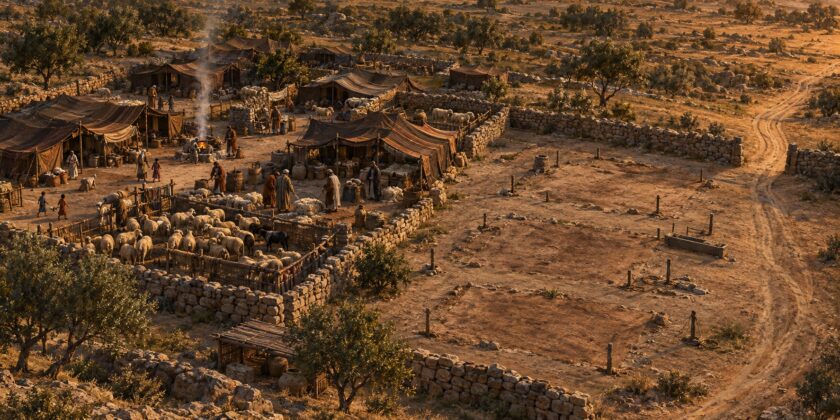
17 Then Jacob stood [and took action] and put his children and his wives on camels;
18 and he drove away all his livestock and [took along] all his property which he had acquired, the livestock he had obtained and accumulated in Paddan-aram, to go to his father Isaac in the land of Canaan.
19 When Laban had gone to shear his sheep, Rachel [went inside the house and] stole her father’s household gods.
20 And Jacob deceived Laban the Aramean (Syrian) by not telling him that he intended to leave and he slipped away secretly.
21 So he fled with everything that he had, and got up and crossed the river [Euphrates], and set his face toward the hill country of Gilead [east of the Jordan River].
⸻
🔬 Metabolic Commentary — Dispersal Under Pressure
God has told Jacob to return. Rachel and Leah have answered together. Now Jacob stands, places his children and wives on camels, and drives away the livestock he has acquired. The agreement in the field becomes the movement of a household. Children, animals, and possessions leave the place where the family has grown, bound for Isaac in Canaan. Years of relationships, responsibility, labor, and increase now have to continue somewhere else.
In ecology, dispersal involves leaving a birthplace or an established breeding site toward possible establishment elsewhere. Biologists distinguish departure, transfer, and settlement because each accomplishes something different. Departure leaves the former site. Transfer crosses the ground between places. Settlement requires becoming established where life can continue. An animal can survive the journey without finding suitable conditions at its destination. Movement alone does not complete the transition.
Jacob’s household has departed and is traveling. Its dependents must be transported, and its living provision must be fed and watered along the way. The animals that represent accumulated wealth also require continuing care. The increase that made departure possible makes the journey demanding. Canaan is named, but it has not been reached.
Laban is away shearing his sheep. During his absence, Rachel steals her father’s household gods. The departure now carries something beyond the possessions Jacob has gathered. The God of Bethel has commanded the return; taking her father’s gods is Rachel’s own choice.
These are religious objects from the house she is leaving. Their significance reaches beyond their material worth. Human symbolic thought allows an object to stand for something beyond itself—a belief, an obligation, or an understanding of powers beyond oneself. Through words and practices, people teach one another those meanings. An object can become valuable because of what someone believes it represents or makes possible. Its appearance alone cannot disclose that value.
Rachel chooses to carry the gods, but the passage does not tell us what she expects from possessing them. The narrator gives the action without her explanation: she steals them.
They leave Laban’s house without an agreed transfer. What is present with Rachel is now absent from her father’s household. Taking the objects does not erase whose possessions they were. Their location changes; the unresolved relationship surrounding their possession travels with them. The same thing can be carried as a gain by one person and discovered as a loss by another.
Jacob also conceals something. He deceives Laban by not telling him that he intends to leave. His earlier request to return home became another negotiation over continued service. In the field, he has recounted wages repeatedly changed. The secret departure occurs against that history of damaged trust.
Rachel takes a possession. Jacob withholds information. Knowledge of the departure would give Laban an opportunity to respond; withholding it allows the household to begin moving before that response. The text does not show what an announced departure would have brought.
Within this concealment lies another gap. Jacob leads the journey without knowing the gods have entered his caravan. Rachel knows what she carries. Directing the household’s movement does not give Jacob knowledge of every choice made within it.
Bargaining and concealment have accompanied this family’s growth. Leaving Laban changes his immediate access to them, while concealment remains part of the departure. God’s command gives the journey its direction without making every choice within it an expression of that command.
“So he fled with everything that he had.” The Euphrates is behind them, and Jacob sets his face toward Gilead. Settlement would mean becoming established where their life together can continue. They have left Laban’s household; their own still has to find its place.
Genesis 31:22–24 (AMP)
22 On the third day [after his departure] Laban was told that Jacob had fled.
23 So he took his relatives with him and pursued him for seven days, and they overtook him in the hill country of Gilead.
24 God came to Laban the Aramean in a dream at night and said to him, “Be careful that you do not speak to Jacob, either good or bad.”

⸻
🔬 Metabolic Commentary — Pursuit Meets a Limit
Word reaches Laban on the third day. Jacob has crossed the Euphrates and set his face toward Gilead, but departure has not yet placed his household beyond Laban’s reach. Laban gathers his relatives and pursues him for seven days.
The distance Jacob gained was real. It was simply not enough to end the relationship of reach between the two households.
This is one of the vulnerabilities of dispersal. Departure changes location immediately, but separation is not complete merely because movement has begun. During transfer, the departing group remains exposed. The former environment may no longer surround it, yet pressures associated with that environment can still cross the distance.
Laban does exactly that.
He leaves the household that Jacob has departed, crosses the intervening ground, and overtakes him in the hill country of Gilead. Jacob has left Laban’s immediate domain, but Laban has demonstrated that his influence can still extend beyond it.
Then the narrative interrupts the pursuit before the confrontation begins.
God comes to Laban in a dream at night and says, “Be careful that you do not speak to Jacob, either good or bad.”
The timing matters. The warning does not prevent Laban from learning of the departure. It does not stop him from gathering his relatives. It does not keep him from making the journey or from reaching Jacob.
The pursuit has already succeeded in closing the distance.
The warning arrives while Laban’s capacity remains intact.
Living biology often depends on this distinction between stopping a response from beginning and limiting a response that is already underway. Blood clotting provides a clear example. When a blood vessel is damaged, clotting proteins activate one another in a rapidly amplifying cascade. That response is necessary. Without it, blood loss can continue.
But the same capacity becomes dangerous if clotting spreads beyond the injured site.
The body therefore carries restraints alongside the machinery of clot formation. Antithrombin inhibits active clotting enzymes. The protein C system helps suppress further coagulation. Healthy vessel surfaces also resist unnecessary clot formation. These controls do not make the blood incapable of clotting. They help keep an activated response from extending without limit.
Capacity remains.
Restraint governs how far that capacity proceeds.
That distinction illuminates the moment in Gilead without turning God’s warning into a biological reflex. Scripture presents deliberate divine intervention: God speaks to Laban and places a limit before the confrontation. Biology only helps us recognize the importance of restraint arriving while a powerful response is already in motion.
The dream does not tell us that Laban has become a different man. His relatives remain with him. Jacob remains within reach. The seven days of pursuit are still behind them. The warning does not erase what Laban has done or establish what he now intends.
It places a limit over what comes next.
Population separation has begun, but the two households are once again close enough to confront one another. Physical distance alone has not secured independence. Something must now govern what happens when the former source of control reaches the departing household again.
The road behind Laban is long.
His kinsmen are beside him.
Jacob is within reach.
And before the first words of confrontation are spoken, a limit has already been set.
Genesis 31:25–32 (AMP)
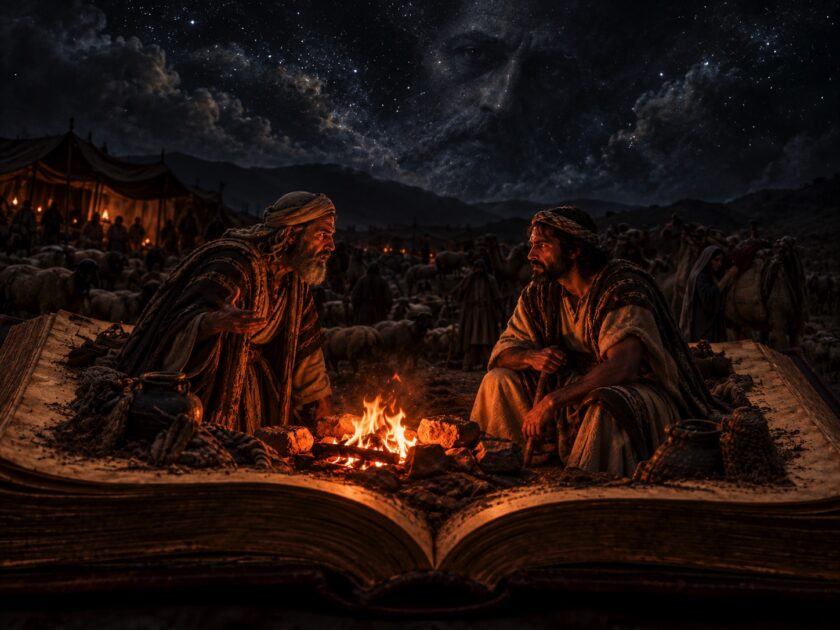
25 Then Laban overtook Jacob. Now Jacob had pitched his tent on the hill, and Laban with his relatives camped on the same hill of Gilead.
26 Then Laban said to Jacob, “What do you mean by deceiving me and leaving without my knowledge, and carrying off my daughters as if [they were] captives of the sword?
27 “Why did you run away secretly and deceive me and not tell me, so that [otherwise] I might have sent you away with joy and with songs, with [music on the] tambourine and lyre?
28 “And why did you not allow me to kiss my grandchildren and my daughters [goodbye]? Now you have done a foolish thing [in behaving like this].
29 “It is in my power to harm you, but the God of your father spoke to me last night, saying, ‘Be careful not to speak to Jacob, either good or bad.’
30 “Now [I suppose] you felt you must go because you were homesick for your father’s house and family; but why did you steal my [household] gods?”
31 Jacob answered Laban, “[I left secretly] because I was afraid, for I thought you would take your daughters away from me by force.
32 “The one with whom you find your gods shall not live; in the presence of our relatives [search my possessions and] point out whatever you find that belongs to you and take it.” For Jacob did not know that Rachel had stolen the idols.
⸻
🔬 Metabolic Commentary — Shared Movement, Unshared Knowledge
The pursuit ends on a hillside. Jacob has pitched his tent on the hill of Gilead, and Laban has camped there with his relatives. The distance Jacob gained has closed again. The household that left and the household that followed now stand within speaking range, and Laban speaks first.
“What do you mean by deceiving me?” He describes Rachel and Leah as daughters carried away “as if they were captives of the sword.” He speaks of the farewell he says he would have given, with songs, tambourine, lyre, and final kisses for his daughters and grandchildren. These are Laban’s claims about the departure, and the reader has already heard the daughters speak for themselves. In the field, Rachel and Leah did not describe themselves as captives. They asked whether any portion or inheritance remained for them in their father’s house, and together they told Jacob to do what God had said. Separation has now brought two descriptions of the same departure into direct confrontation: Laban describes what left as still belonging within his claim, while Rachel and Leah had already agreed to go.
Then Laban says aloud what the previous paragraph left suspended: “It is in my power to harm you.” The capacity remains. The warning did not scatter Laban’s relatives, prevent him from crossing the distance, or make him powerless. Yet he immediately acknowledges the limit placed upon that power. In verse 24, God had told him, “Be careful that you do not speak to Jacob, either good or bad.” Now Laban repeats that warning in Jacob’s hearing. The restraint comes from outside Laban’s own allegiance. He does not say, “my God warned me.” He says, “the God of your father spoke to me.”
That distinction becomes harder to ignore in the very next line. The God of Jacob’s father has just restrained Laban, yet Laban continues, “Why did you steal my gods?” The text does not tell us outright that Laban is deliberately defying the warning, and the phrase “good or bad” should not be forced into a meaning the passage does not explain. Still, the tension is plain. Laban remains under the restraint of a God he does not claim as his own while pressing Jacob on behalf of the gods he does. The warning limits Laban. It does not make the confrontation disappear.
And it does not guard what Jacob is about to say.
Laban’s accusation is direct: “Why did you steal my gods?” The reader already knows something Jacob does not. Back in verse 19, Genesis told us, “Rachel … stole her father’s household gods.” The theft is real, but Laban assigns it directly to Jacob, the man leading the household away. Jacob neither committed that act nor knew it had occurred. Laban therefore confronts the leader of the group with an act hidden inside the group itself.
Jacob answers what he is able to answer. He explains why he left secretly: “Because I was afraid.” He believed Laban might take Rachel and Leah from him by force. Whether Laban actually would have done so, the passage does not establish. Jacob is reporting his own reason for leaving. That part he knows. He also knows what he intended to carry out of Laban’s country: his wives and children, his servants, his flocks, and the possessions he had openly gathered.
Then the accusation draws an absolute response from him: “The one with whom you find your gods shall not live.” Laban has attributed Rachel’s concealed act to Jacob. Jacob answers from what he knows about his own conduct, but his declaration reaches across the entire household. He knows he did not take the gods. He does not know that no one traveling with him did. Those are different claims, and the distance between them is large enough to place a life beneath a sentence.
That gap is not unusual in coordinated living groups. Collective movement does not require every member to possess the same information. Models of animal groups have shown that a relatively small informed minority can influence the direction of a much larger group even when the uninformed members do not know who possesses the directional information. Cohesion can arise because individuals adjust their movement in relation to those nearby while only some possess knowledge about where the group is going. The group can therefore travel together without every member sharing the same map, the same signals, or the same awareness.
Jacob’s household exposes the reverse side of that principle. Here the man directing the movement is himself missing information held by someone traveling within the group. Jacob can lead wives, children, servants, camels, and flocks across a river without knowing everything that crossed with them. A household that moves as one has not become one mind.
And now the storyteller steps into view.
We have heard this voice all along. Most of the time we simply call it Genesis. It carries us from scene to scene, tells us who moved, who spoke, who married, who conceived, who departed, and who returned. Usually the voice stays nearly invisible behind the events. The characters speak. God speaks. The action unfolds. The storyteller does not call attention to itself.
But occasionally that voice steps forward far enough for the reader to notice it.
Genesis has done this before. At the beginning of Abraham’s ordeal, before Abraham knew what the command concerning Isaac would become, the narrator told the reader, “God tested Abraham.” Abraham himself was not given that explanation before the command unfolded. The reader was allowed to know something about Abraham’s situation that Abraham did not know. Genesis 22-24
Now the same storytelling voice surfaces again:
“For Jacob did not know that Rachel had stolen the idols.”
Jacob does not know.
We do.
The reader has carried that information since verse 19, when Genesis told us, “Rachel … stole her father’s household gods.” Jacob crossed the Euphrates without that knowledge, but the reader carried it across with him. Now, at the exact moment Jacob declares that whoever possesses those gods shall not live, the narrator reminds us that the man speaking does not know everything inside the household he is speaking for.
The telling itself now begins to resemble the condition inside the story. Rachel knows what she has done. Laban knows his gods are missing. Jacob knows why he fled and knows that he did not take them. The reader has been deliberately given information that none of the men possess in full. Knowledge is unevenly distributed not only inside the household, but across the narrative itself.
The storyteller has arranged the reader inside the same informational pattern the biology helps explain.
Shared movement does not produce shared knowledge.
Shared participation in the story does not produce shared knowledge either.
Jacob stands inside the event with one field of awareness. Laban stands inside it with another. Rachel carries another. The reader stands outside all three because the storyteller has given us pieces none of them possess together.
For a moment, Genesis lets us see the gaps.
Neither man holds the whole picture. Laban is right that his gods are somewhere within the departing household but wrong when he directly assigns the theft to Jacob. Jacob is right that he did not steal them, but his declaration extends beyond what he actually knows. The narrator alone places the reader where those partial views can be seen together.
The danger is not simply that Jacob lacks information. No leader possesses complete knowledge of every action occurring among the people he leads. The danger is that his declaration reaches farther than the evidence available to him. Shared movement has produced a functioning departing household. It has not produced shared knowledge.
Jacob knows why he left. He knows what he feared. He knows what he intended to carry away. He does not know everything that came with him.
And he has told Laban to search.
Genesis 31:33–35 (AMP)
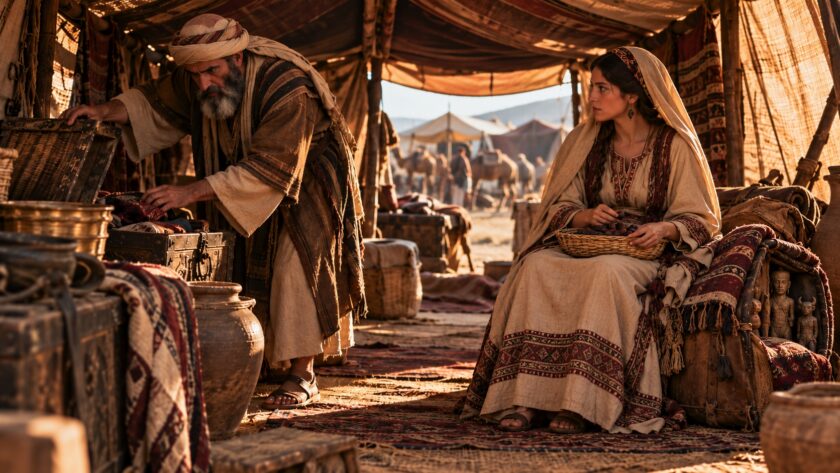
33 So Laban went into Jacob’s tent and into Leah’s tent and the tent of the two maids, but he did not find them. Then he came out of Leah’s tent and entered Rachel’s tent.
34 Now Rachel had taken the household idols and put them in the camel’s saddlebag and sat on them. Laban searched through all her tent, but did not find them.
35 So Rachel said to her father, “Do not be displeased, my lord, that I cannot rise before you, for the manner of women is on me and I am unwell.” He searched [further] but did not find the household idols.
⸻
🔬 Metabolic Commentary — Loss, Expectation, and Mistrust
Laban has caught up with the household that left him, but something important is still missing. His household gods have been taken, and he wants them returned. Jacob has invited him to search, declaring that whoever possesses them shall not live, unaware that Rachel is the one who has stolen them.
These are not ordinary possessions. They are religious objects belonging to Laban’s household, potentially connected to years of familiar practice, belief, and family history. Genesis does not tell us how old they are, whether they were inherited, or how they were used. But their disappearance matters enough for Laban to demand their recovery.
Human beings organize their lives around familiar places, meaningful objects, and repeated routines. Through experience, the brain forms associations between surroundings, memories, and expected behavior. The hippocampus helps connect experiences with their contexts, while circuits involving the basal ganglia support habits formed through repetition. When something meaningful disappears, those learned associations do not disappear with it. Familiar cues can still activate memories and expectations associated with what is missing, directing attention toward its absence and sometimes motivating attempts at recovery.
Laban’s gods belonged to the religious life of the household Rachel and Leah grew up in. Whatever their history, Laban wants them returned, while Rachel has carried them into the household that is leaving him. Father and daughter now have opposing intentions concerning the same possessions.
The search begins amid mistrust that was already present. Jacob departed without informing Laban and later explained that he feared Laban would take his wives by force. Rachel and Leah had described their father as someone who sold them and consumed their portion. Now Laban accuses Jacob of theft, and Jacob, certain that he did not take the gods, invites him to examine the tents.
But allowing a search does not restore trust. It makes the suspicion visible.
Laban enters Jacob’s tent, Leah’s tent, and the tents of the two female servants. What began as an accusation between two men becomes an examination of the entire departing household. Each tent is subjected to inspection. People whose departure Laban has challenged now have their belongings searched, whether or not they had anything to do with the missing gods.
When something valued disappears, the brain can continue to generate expectations based on what was previously familiar. Those expectations help direct attention and motivate searching, but they cannot supply information a person does not possess. Laban knows his gods are missing, yet he does not know where they have been taken. His search is genuine, but Rachel’s concealment keeps the evidence beyond his discovery. And because he cannot identify the person responsible, his suspicion extends through the departing household. One person’s concealed action has made many people the objects of inspection.
The irony is that the person responsible is also the one preventing discovery.
Rachel has placed the household gods inside a camel’s saddlebag and seated herself upon it. When her father reaches her tent, she explains that she cannot rise because the customary condition of women is upon her. The narrator does not verify her condition or explain why Laban does not require her to stand. He searches the tent, but the objects remain hidden.
Rachel’s concealment also carries a danger beyond the original theft. Jacob has declared that whoever possesses the gods shall not live. Genesis does not tell us whether Rachel heard those words, but the reader knows what discovery could mean for her.
When exposure threatens serious consequences, defensive behavior may involve controlling what others can observe. Concealment can preserve an appearance of cooperation while withholding information that would change the situation. Rachel does not flee or openly resist her father. She remains seated, addresses him respectfully, and offers an explanation for her posture while keeping the objects concealed.
The same loss has brought three different positions into conflict. Laban searches for what he wants returned. Jacob permits the inspection, confident that he did not steal the gods and unaware that his household contains them. Rachel alone among the three knows where the missing objects are, and she keeps them concealed.
Laban’s search is directed by what he remembers and wants restored, while Jacob’s confidence rests on an incomplete understanding of his household. Rachel’s knowledge allows her to anticipate what discovery would reveal and act to prevent it. Their different expectations shape their actions during the same search, but only Rachel knows where the missing gods are.
Laban has already protested the departure of his daughters and grandchildren. Now Rachel, the younger daughter Jacob loved and served fourteen years to marry, is before him. Her marriage had already involved substitution and additional labor under Laban’s authority. Yet here she sits, concealing her father’s household gods while he searches for them. The search has brought Laban directly before his daughter, unaware that the objects he seeks are hidden within the saddlebag beneath her.
“He searched [further] but did not find the household idols.”
The inspection ends without discovery. Rachel remains seated, Jacob remains unaware, and Laban has not recovered what he sought.
The theft has not been exposed. The mistrust has not been repaired. The household gods remain concealed within the family that has separated from Laban, carrying an unresolved part of the former household into its future.
What was lost has not been found.
What was stolen remains concealed.
Genesis 31:36–42 (AMP)
36 Then Jacob became angry and argued with Laban.
And he said to Laban, “What is my fault? What is my sin that you pursued me like this?
37 Although you have searched through all my possessions, what have you found of your household goods? Put it here before my relatives and your relatives, so that they may decide [who has done right] between the two of us.
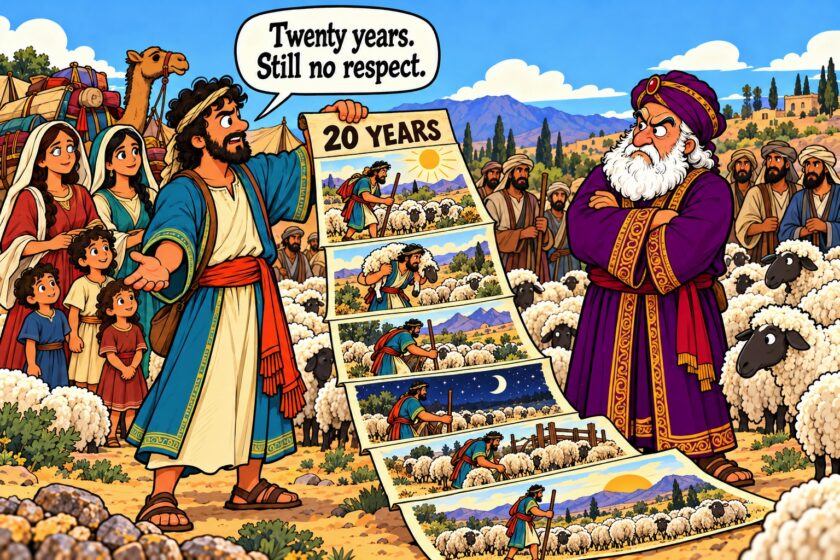
38 These twenty years I have been with you; your ewes and your female goats have not lost their young, nor have I eaten the rams of your flocks.
39 I did not bring you the torn carcasses [of the animals attacked by predators]; I [personally] took the loss. You required of me [to make good] everything that was stolen, whether it occurred by day or night.
40 This was my situation: by day the heat consumed me and by night the cold, and I could not sleep.
41 These twenty years I have been in your house; I served you fourteen years for your two daughters and six years for [my share of] your flocks, and you have changed my wages ten times.
42 If the God of my father, the God of Abraham, and [the Feared One] of Isaac, had not been with me, most certainly you would have sent me away now empty-handed. God has seen my affliction and humiliation and the [exhausting] labor of my hands, so He rendered judgment and rebuked you last night.”
⸻
🔬 Metabolic Commentary — The Body Keeps the Ledger of the Increase
The search has ended without recovery. Laban has entered the tents, examined what he can reach, and found nothing. The household gods remain concealed. Jacob, still unaware of the theft, becomes angry with the man who has followed his departing household and searched its possessions.
“What is my fault? What is my sin that you pursued me like this?”
He calls for evidence before their relatives. If Laban has found something belonging to his household, let him place it before them so they can judge between the two men. Jacob’s confidence reaches beyond his knowledge of what the household carries. Yet the years of service he now brings forward are years he knows firsthand.
“These twenty years I have been with you.”
During those twenty years, Jacob has sustained Laban’s flocks and become the head of a household of his own. That household has now departed, and Laban has followed it. Before their relatives, Jacob recounts the years that brought them to this confrontation: the service he gave, the losses he absorbed, and the provision with which God has enabled him to leave.
The capacity to continue elsewhere developed through costly years of remaining. Jacob now makes those years part of the judgment he asks the relatives to hear.
He begins with the flock. The ewes and female goats did not lose their young. He did not eat the rams. When predators tore animals, he absorbed the loss personally. Whatever was stolen, whether by day or night, Laban required him to restore. The work included tending living animals, watching over them, and bearing losses that his vigilance could not always prevent.
Then he names what those years repeatedly required of his body.
“By day the heat consumed me and by night the cold, and I could not sleep.”
Heat, cold, and sleeplessness belong inside the twenty years. They give bodily substance to a span that might otherwise pass in a sentence. Keeping the flock alive occupied days and nights that were also days and nights of Jacob’s own life.
Living bodies must distribute available energy among activity, maintenance, recovery, and reproduction. Energy spent in sustained work has to be supplied, while the body’s other needs continue. Time also places limits on what can be done. Hours spent watching animals through the night cannot simultaneously be hours of sleep. The flock may be protected while the keeper’s need for recovery remains unmet.
Repeated demands require repeated adjustment. Circulation, energy release, temperature regulation, and alertness change to help the body continue. When such demands remain prolonged and recovery is inadequate, those protective responses can contribute to cumulative physiological strain, often described as allostatic load. Jacob’s testimony does not establish a disease or measure that burden. It names the prolonged conditions under which his work continued.
The household now traveling with him has grown through those years of continuing effort. Its provision makes departure possible, but the presence of that provision does not show that the years were inexpensive. The animals can be counted. The nights spent keeping them cannot be recovered.
Rest can renew the capacity for another day’s labor. It cannot return the day already spent. Across twenty years, work becomes part of the course of a life: what a person repeatedly attends to, accepts responsibility for, and gives time to sustain. Jacob brings that committed life into a confrontation over whether he can now continue elsewhere.
Abundance records what accumulated. It does not display everything expended to preserve it.
Jacob places the years in order: fourteen for the daughters and six for the flock. These were years of service under stated arrangements, and he says that Laban changed his wages ten times. He brings the completed work and the altered terms before the same witnesses. Laban has benefited from Jacob’s continued ability to meet the demands. Now Jacob insists that the service already given must count in how his departure is judged.
His marriages, children, and provision belong to the life formed during those years. The household leaving Laban’s domain has responsibilities and a future of its own. Jacob’s continuing ability to work will be needed within it. That ability does not make his past service unfinished.
Nor does hardship itself create the direction of the departure. God has already commanded Jacob to return. The account of labor answers the man who has pursued him: Jacob has fulfilled years of responsibility, and he challenges the grounds on which Laban now treats him as an offender.
His ignorance concerning Rachel remains. The hidden theft does not disappear because his grievance is substantial, and his grievance does not disappear because something has been hidden from him.
Yet Jacob does not attribute his preservation to labor alone.
“If the God of my father, the God of Abraham, and the Feared One of Isaac, had not been with me, most certainly you would have sent me away now empty-handed.”
He names the outcome he believes Laban would have imposed, then names the One who prevented it. God has seen his affliction and the labor of his hands. Jacob receives the warning given to Laban the previous night as divine judgment upon the treatment he has endured.
God’s protection does not erase those years or make their demands insignificant. The labor is part of what God has seen. Jacob’s provision and his affliction stand together in the testimony: he has been preserved through a service whose cost still deserves recognition.
The years Jacob names have helped bring his household to the point where it can continue beyond Laban’s domain. His departure has accomplished the movement; his speech now challenges the claim that his life must remain at Laban’s disposal. The confrontation is still unresolved, but the service already given cannot become an unlimited demand upon the years ahead.
The capacity to keep giving does not establish an unlimited obligation to give.
Genesis 31:43–55 (AMP)
43 Laban answered Jacob, “These women [that you married] are my daughters, these children are my grandchildren, these flocks are [from] my flocks, and all that you see [here] is mine. But what can I do today to these my daughters or to their children to whom they have given birth?
44 So come now, let us make a covenant, you and I, and let it serve as a witness between you and me.”
45 So Jacob took a stone and set it up as a [memorial] pillar.
46 Jacob said to his relatives, “Gather stones.” And they took stones and made a mound [of stones], and they ate [a ceremonial meal together] there on the mound [of stones].
47 Laban called it Jegar-sahadutha (stone monument of testimony in Aramaic), but Jacob called it Galeed.
48 Laban said, “This mound [of stones] is a witness [a reminder of the oath taken] today between you and me.” Therefore he [also] called the name Galeed,
49 and Mizpah (watchtower), for Laban said, “May the Lord watch between you and me when we are absent from one another.
50 If you should mistreat (humiliate, oppress) my daughters, or if you should take other wives besides my daughters, although no one is with us [as a witness], see and remember, God is witness between you and me.”
51 Laban said to Jacob, “Look at this mound [of stones] and look at this pillar which I have set up between you and me.
52 This mound is a witness, and this pillar is a witness, that I will not pass by this mound to harm you, and that you will not pass by this mound and this pillar to harm me.
53 The God of Abraham [your father] and the God of Nahor [my father], and the god [the image of worship] of their father [Terah, an idolater], judge between us.” But Jacob swore [only] by [the one true God] the Fear of his father Isaac.
54 Then Jacob offered a sacrifice [to the Lord] on the mountain, and called his relatives to the meal; and they ate food and spent the night on the mountain.
55 Early in the morning Laban got up and kissed his grandchildren and his daughters [goodbye] and pronounced a blessing [asking God’s favor] on them. Then Laban left and returned home.
⸻
🔬 Metabolic Commentary — Maintaining Cellular Boundaries
Jacob has finished naming the years he gave. Laban answers by naming what he still calls his own.
“These women that you married are my daughters, these children are my grandchildren, these flocks are from my flocks, and all that you see here is mine.”
The family relationships remain. Yet Laban gathers those relationships and the flocks beneath a claim extending over everything before him. Jacob has described the service through which his household grew. Laban still speaks from the place where that growth began, as though its origin keeps it within his possession.
Then he proposes a covenant.
His claim has not been withdrawn. The agreement will nevertheless place limits on what either man may do. Jacob’s household has already moved away, and Laban has already closed the distance. Their continued separation requires something that departure alone did not establish: terms governing renewed approach.
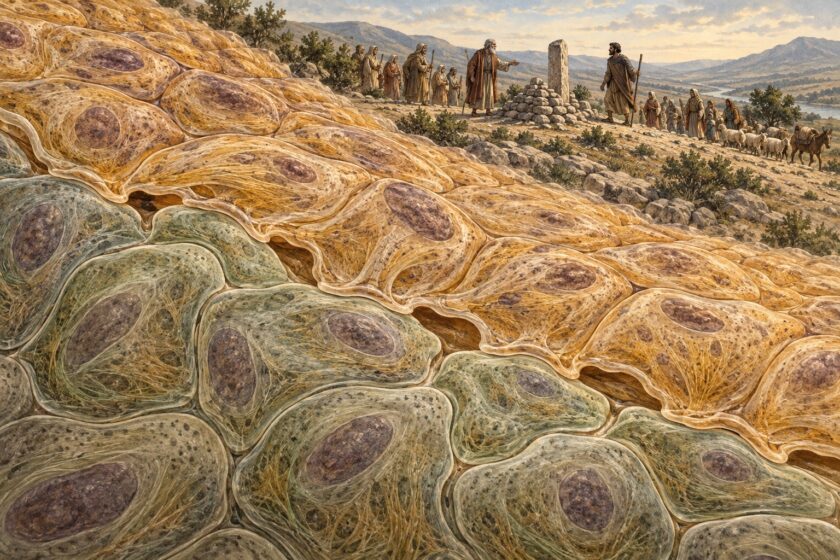
Developing tissues encounter a comparable problem. Distinct cell populations must retain their organization while growing and moving beside one another. In experiments with early frog embryos, researchers observed cells from neighboring tissue layers repeatedly attaching and detaching as one layer moved along the other.
This behavior involves proteins anchored in the cell surface: EphB receptors and their binding partners, ephrinBs. Contact brings these proteins together, activating signals inside the cells. Downstream regulators, including RhoA and Rac, control the cytoskeleton—the internal framework through which cells change shape and move. These signals support temporary release at the contact, followed by renewed attachment and another round of signaling.
When researchers disrupted this pathway, detachment decreased and the tissues could become intermixed. The distinction between the layers depended on active responses where they met. Repeated contact could continue while regulated release helped prevent incorporation into the neighboring tissue.
These layers remain parts of one embryo. Their behavior illuminates one feature of the encounter before Jacob and Laban: continued distinction depends partly on what renewed contact is allowed to produce.
Jacob raises a pillar and asks his relatives to gather stones. The mound gives their agreement a lasting, recognizable place. Laban and Jacob name it in their respective languages, and Laban repeatedly calls it a witness.
The terms give that witness its meaning.
“I will not pass by this mound to harm you,” Laban says, “and … you will not pass by this mound and this pillar to harm me.”
The restriction concerns harmful crossing. It leaves room for the family relationship to continue while binding both men concerning how they may approach one another. Laban’s ability to reach Jacob has already been demonstrated. Now that reach is placed under a declared obligation.
Jacob accepts a corresponding restraint. His departure does not give him permission to harm the household he has left. The covenant governs conduct in both directions, securing separation through obligations each man must keep.
The stones will remain visible after the men depart, but their continued presence cannot perform that obedience for them. The agreement must become conduct when another opportunity to cross arises.
Its demands also reach into the household traveling with Jacob.
“If you should mistreat … my daughters, or if you should take other wives besides my daughters,” Laban says, “God is witness between you and me.”
Rachel and Leah agreed to leave. Their agreement did not surrender their claim to proper treatment. Jacob’s freedom from Laban’s control does not place their lives at his unlimited disposal. Their father’s absence will change what he can personally observe; Jacob’s responsibility toward them continues.
The covenant therefore limits Laban’s reach while placing Jacob’s own conduct under judgment. Independent continuation carries obligations within it.
“May the Lord watch between you and me when we are absent from one another.”
Absence belongs inside the agreement. The men are preparing for lives beyond each other’s sight, and Laban explicitly names the possibility that no human witness will be present. God’s witness extends to the treatment and conduct that distance will conceal from them.
Jacob swears by the Fear of his father Isaac. The God he has just named as seeing his affliction and exhausting labor is also the One before whom he now undertakes an obligation. Having been wronged does not remove his accountability for what he does next.
Jacob offers sacrifice and calls his relatives to eat. They share food and spend the night on the mountain. The pursuit has reached an agreement under which the men can part.
The meal does not require the reader to forget what remains unresolved. Laban’s opening declaration still belongs to the encounter. Jacob’s years remain years already given. The household gods remain unrecovered, and Jacob’s ignorance concerning Rachel remains. A real limit has been established amid an unfinished history.
In the morning, Laban kisses his daughters and grandchildren and blesses them. The farewell he said he had been denied now occurs. His family receives his blessing while continuing beyond his domain.
The chapter began with Jacob’s increase spoken of as a loss from Laban’s house. It ends with Laban still claiming what has grown there, yet departing under terms that limit his future action. The claim remains in his speech; the household continues on its journey.
Laban returns home. The stones remain as witnesses to how the separation is to endure.
⸻
Chapter Systems Thesis
Growth can make separate continuation possible before the conditions protecting it have been secured. Departure changes location, while durable separation requires limits that remain effective through renewed interaction. What leaves carries provision, relationships, accumulated cost, and unresolved history. Continued independence becomes possible without erasing those connections or releasing responsibility toward the lives within the departing household. The boundary gives future conduct a limit while allowing what has grown to continue elsewhere.