
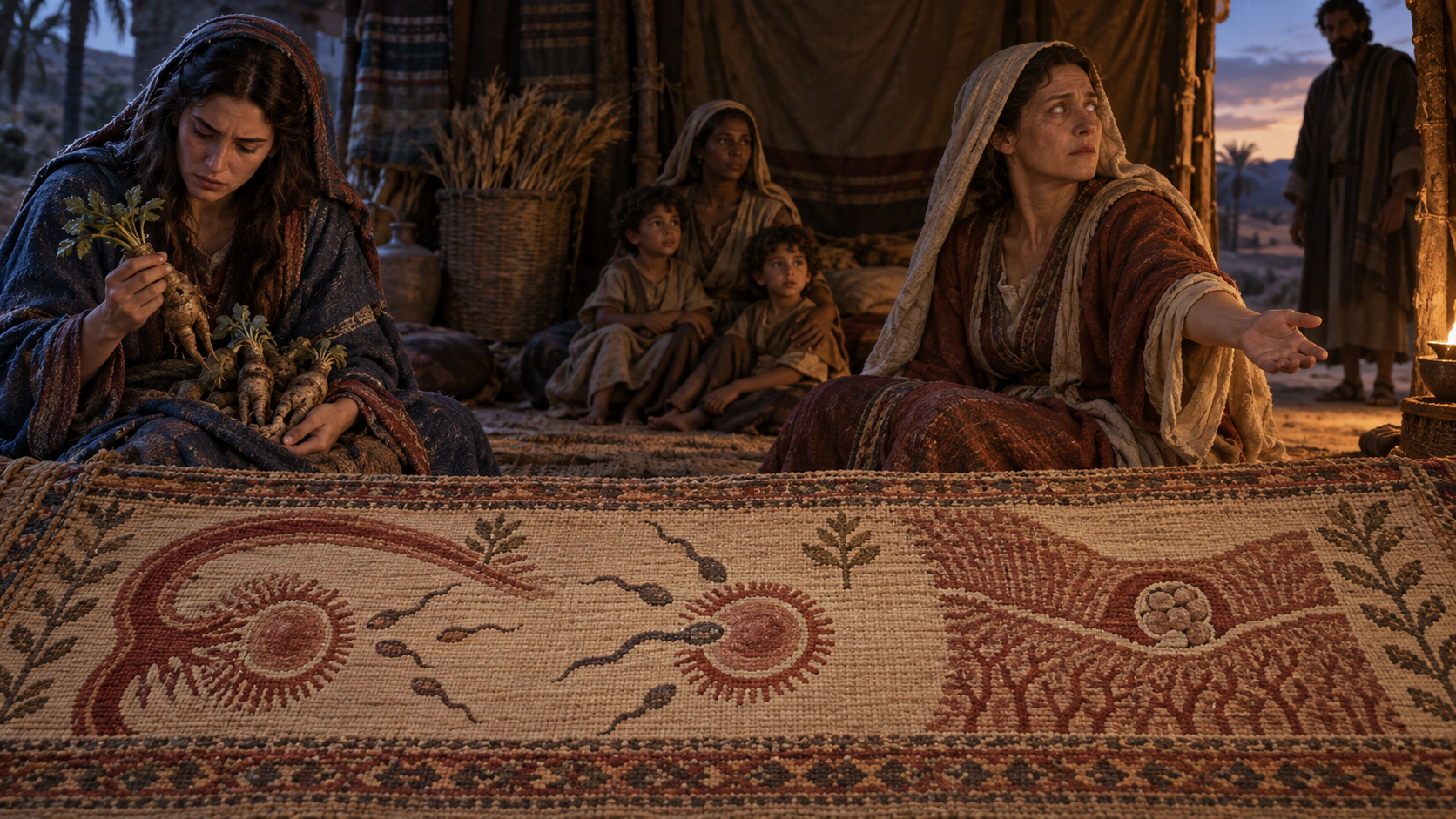
Genesis 30:1–8 (AMP)
1 When Rachel saw that she conceived no children for Jacob, she envied her sister, and said to Jacob, “Give me children, or else I will die.”
2 Then Jacob became furious with Rachel, and he said, “Am I in the place of God, who has denied you children?”
3 She said, “Here, take my maid Bilhah and go in to her; and [when the baby comes] she shall deliver it [while sitting] on my knees, so that by her I may also have children [to count as my own].”
4 So she gave him Bilhah her maid as a [secondary] wife, and Jacob went in to her.
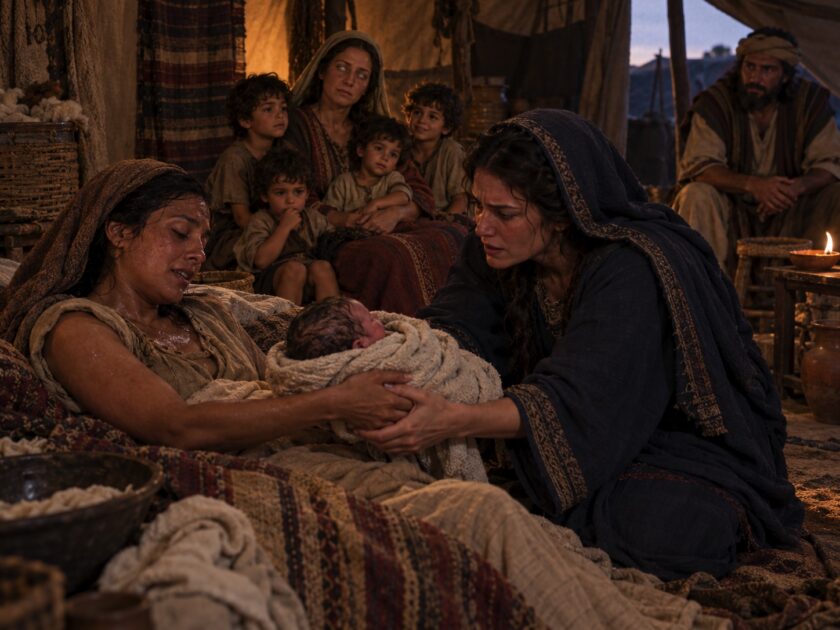
5 Bilhah conceived and gave birth to a son for Jacob.
6 Then Rachel said, “God has judged and vindicated me, and has heard my plea and has given me a son [through my maid].” So she named him Dan (He judged).
7 Bilhah, Rachel’s maid, conceived again and gave birth to a second son for Jacob.
8 So Rachel said, “With mighty wrestlings [in prayer to God] I have struggled with my sister and have prevailed.” So she named him Naphtali (my wrestlings).
⸻
🔬 Metabolic Commentary — Rivalry Recruits Another Pathway
Genesis 29 closed with a household already divided. Rachel is loved and barren. Leah has borne four sons and remains insufficiently loved. Preference survived the night. Fertility did not follow it. Transmission began through the wife Jacob had not placed at the center.
Chapter 30 does not repair that split. It shows what the household does when the preferred pairing still does not produce the desired future.
“When Rachel saw that she conceived no children for Jacob, she envied her sister.”
Rachel’s barrenness is not new. The comparison is.
She is responding to something she can see every day. Leah’s children exist. Rachel’s do not. The difference is embodied and public within the same household. What had been a reproductive limitation now becomes a relative one: the future appears to be arriving through her sister.
Then Rachel turns the absence into a demand. “Give me children, or else I will die.” The words carry grief, but they also place the desired outcome in Jacob’s hands as though he possesses the missing command.
Jacob answers in anger: “Am I in the place of God?” The question establishes a boundary the rest of the chapter will continue testing.
Jacob can love Rachel. He can share her bed. He can participate in the conditions under which conception might occur. He cannot command a womb.
Human reproduction depends upon a sequence that desire alone cannot order into existence. Ovulation must occur. Sperm and egg must meet under viable conditions. Fertilization must be followed by successful transport and implantation, and pregnancy must then be sustained through continuing hormonal, circulatory, and metabolic adaptation.
Sexual access creates opportunity. It does not issue conception as an instruction. Influence lives in the household. Command does not.
Rachel therefore does not wait for the preferred pair to produce what she wants. She recruits another pathway.
“Here, take my maid Bilhah… so that by her I may also have children [to count as my own].”
The arrangement is precise. Bilhah will bear the child. Rachel will receive the child upon her knees and count the birth within her own household claim. Access has been rearranged so that increase can occur while Rachel’s original limitation remains.
This is compensation, not restoration.
Living bodies often preserve an important function by recruiting capacity through another available route. The result may be genuine and useful while the original limitation remains unchanged. Compensation can therefore succeed without restoring what first failed.
That distinction is visible here because Genesis repeatedly names the woman whose body actually performs the reproductive work. “Bilhah conceived.”
Bilhah ovulates. Bilhah conceives. The embryo implants within Bilhah. Bilhah’s circulation and metabolism sustain the developing child. Bilhah carries the pregnancy. And Bilhah gives birth.
The household can count the son as Rachel’s. It cannot count Bilhah’s conception as Rachel’s. The new child is real. Rachel’s barrenness is still real beside him.
Rachel names the boy Dan—“He judged.”
“God has judged and vindicated me, and has heard my plea and has given me a son.”
The name reveals how much weight the birth is being asked to carry. Dan is not received only as a child. Rachel receives him as a verdict. God has heard. A son has been given. Something, in Rachel’s reading of the household, has now been decided in her favor.
But a birth can report that conception occurred. It cannot report whether Rachel has displaced Leah. It cannot report whether love has finally been matched by reproductive output. It cannot report whether the rivalry itself has been healed.
When a valid signal is asked to answer the wrong question, increase can occur while the underlying conflict remains untouched.
Then Bilhah conceives again. A second son is born through the same route. Rachel names him Naphtali—“my wrestlings.”
“With mighty wrestlings I have struggled with my sister and have prevailed.”
The language the text records is judicial and competitive rather than simply celebratory. Dan is named around judgment. Naphtali is named around wrestling.
The household now holds six sons if Leah’s four are counted with these two. Continuity is no longer scarce in the simple sense. The household is growing. Yet Rachel’s speech is still organized around Leah.
That is the deeper consequence of compensation when comparison remains the governing pressure. The additional route has produced exactly what it was recruited to produce: children have entered the household.
The workaround works. The original limitation remains. And the rivalry has found new material through which to express itself.
Genesis 30:9–21 (AMP)
9 When Leah saw that she had stopped bearing [children], she took Zilpah her maid and gave her to Jacob as a [secondary] wife.
10 Zilpah, Leah’s maid, gave birth to a son for Jacob.
11 Then Leah said, “How fortunate!”
So she named him Gad (good fortune).
12 Zilpah, Leah’s maid, gave birth to a second son for Jacob.
13 Then Leah said, “I am happy! For women will call me happy.”
So she named him Asher (happy).
14 Now at the time of wheat harvest Reuben [the eldest child] went and found some mandrakes in the field, and brought them to his mother Leah.
Then Rachel said to Leah, “Please give me some of your son’s mandrakes.”
15 But Leah answered, “Is it a small thing that you have taken my husband? Would you take away my son’s mandrakes also?”
So Rachel said, “Jacob shall sleep with you tonight in exchange for your son’s mandrakes.”
16 When Jacob came in from the field in the evening, Leah went out to meet him and said, “You must sleep with me [tonight], for I have in fact hired you with my son’s mandrakes.”
So he slept with her that night.
17 God listened and answered [the prayer of] Leah, and she conceived and gave birth to a fifth son for Jacob.
18 Then Leah said, “God has given me my reward because I have given my maid to my husband.”
So she named him Issachar.
19 Leah conceived again and gave birth to a sixth son for Jacob.
20 Then Leah said, “God has endowed me with a good [marriage] gift [for my husband]; now he will live with me [regarding me with honor as his wife], because I have given birth to six sons.”
So she named him Zebulun.
21 Afterward she gave birth to a daughter and named her Dinah.
⸻
🔬 Metabolic Commentary — The Strategy Spreads; Access Becomes Exchange
Rachel has already shown the household what can be done when the desired route does not yield. Unable to conceive, she gave Bilhah to Jacob and claimed the two sons Bilhah bore. Rachel’s own limitation remained, but her side of the household increased.
Now Leah sees that she has stopped bearing. Her condition is not the same as Rachel’s, for Leah has already borne four sons. Continuity has begun through her, but her bearing has paused, while Rachel has demonstrated that another woman’s pregnancies can keep the count moving.
So Leah copies the strategy and gives Zilpah to Jacob. Rachel added another pathway because she had borne no children of her own. Leah adds one because the pathway through her own body has gone quiet. Once a behavior produces visible gain, competition gives the other side reason to imitate it.
What began as compensation becomes competition.
Zilpah conceives, and Zilpah bears. Leah claims and names the sons, but Genesis does not allow the woman who carried them to disappear. The household can count Gad and Asher under Leah’s claim, but it cannot make Zilpah’s pregnancies Leah’s. Zilpah’s body carries the children, supplies their growth, and endures their birth. Social claim can be reassigned; biological cost cannot.
Leah names the first son Gad—“good fortune”—and the second Asher—“happy,” saying, “Women will call me happy.” The earlier names repeatedly returned to Leah’s lack of Jacob’s love. Gad and Asher turn instead toward fortune, happiness, and public standing. The rivalry is no longer only about whether there will be children. It has become a question of whose claim will increase.
Then the field enters the contest.
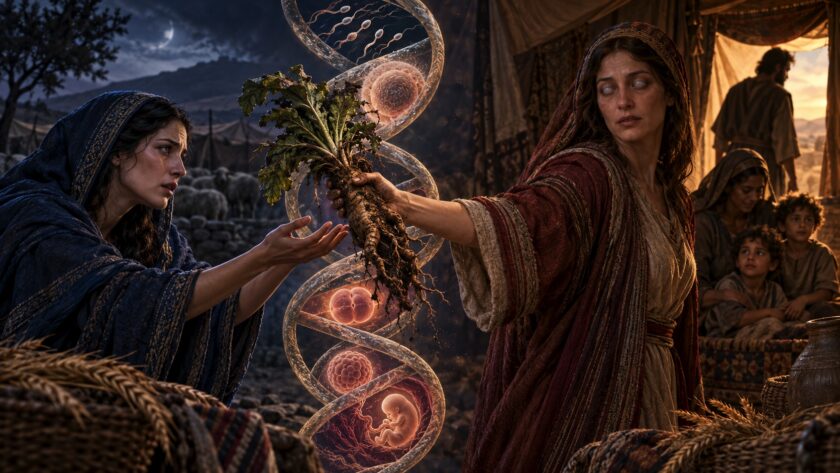
During the wheat harvest, Reuben finds mandrakes and brings them to Leah. Rachel desires the mandrakes because the plant is regarded as an aid to fertility. Genesis does not establish whether they work; it shows what Rachel believes they might do and what that belief makes them worth. Desperation gives uncertain remedies value, and their promise turns the mandrakes into currency before they ever become medicine.
Leah answers Rachel’s request by naming the deeper wound: “Is it a small thing that you have taken my husband? Would you take away my son’s mandrakes also?” Jacob’s preference remains directed toward Rachel, and Leah experiences that preference as the loss of her own husband. Rachel has Jacob’s affection but has not conceived. Leah has borne his children but still does not possess the companionship she hoped those births would produce.
Rachel offers Leah one night with Jacob in exchange for the mandrakes. A plant associated with fertility moves in one direction, and access to Jacob moves in the other. Rachel wants the plant. Leah wants her husband. Each sister trades what the other wants.
When Jacob returns from the field, Leah goes out to meet him and says, “You must sleep with me tonight, for I have in fact hired you with my son’s mandrakes.” The agreement has already been made. Jacob is told its terms, and he sleeps with Leah that night.
The exchange changes real conditions. Intercourse creates a reproductive opportunity, just as timing, fertility, and bodily health influence whether conception is possible. Yet access is not conception. Ovulation must occur. Viable sperm must be present. Fertilization, implantation, and continued development must come into coordination within a living body.
The sisters can negotiate a night. They cannot coordinate everything that must follow.
Rachel receives the mandrakes. Leah receives the night. Leah conceives.
The sequence creates a deliberate contrast, but sequence alone does not establish cause. Genesis does not credit the mandrakes with opening fertility, nor does it say that Leah stopped bearing because she lacked access to Jacob. It gives its own explanation: “God listened and answered [the prayer of] Leah.”
God’s listening does not remove biology from the story. It places biology within the created order from which life comes. The bargain changes opportunity. It does not create life by its own authority.
Leah bears a fifth son and names him Issachar, saying that God has given her a reward because she gave Zilpah to Jacob. The language of hiring, exchange, and reward now enters the naming of a child. Issachar is not merely payment, but the arrangements surrounding his birth shape how Leah understands his arrival.
Then Leah conceives again and bears Zebulun. She calls him a good marriage gift, yet her old hope returns: “Now he will live with me.” At Judah’s birth, Leah had stopped predicting what another son would make Jacob do and had praised the LORD. Genesis never said that her wound had disappeared, and the renewed competition draws it back into speech.
Leah has now given Jacob six sons, yet she still hopes that reproduction will produce companionship. The births are real, and the gift is real, but neither can command Jacob’s affection. Fertility cannot command dwelling any more than love can command fertility.
Afterward Leah gives birth to a daughter and names her Dinah—“Judgment” or “Justice.” A Hebrew listener would hear in her name the same root heard earlier in Dan, whom Rachel named when she believed God had judged in her favor. Genesis does not explain why Leah chose the name, but the echo is present. The language of judgment now stands on both sides of the rivalry. The children are being treated as signs of fortune, reward, standing, and vindication, although they cannot determine either woman’s worth.
By the end of the passage, the household has grown through Leah, Bilhah, and Zilpah, yet none of that increase has settled the conflict that organized it. Their choices have altered access, timing, and opportunity, but the household keeps treating influence as authority. A condition becomes a command, a child becomes a verdict, and another person becomes an instrument for obtaining the desired result.
The body does not stand apart from God. It bears the order God gave it.
Human hands may arrange the conditions.
Life does not become theirs to command.
Genesis 30:22–24 (AMP)
22 Then God remembered [the prayers of] Rachel, and God thought of her and opened her womb [so that she would conceive].
23 So she conceived and gave birth to a son; and she said, “God has taken away my disgrace and humiliation.”
24 She named him Joseph (may He add) and said, “May the LORD add to me another son.”

⸻
🔬 Metabolic Commentary — The Womb Opens; Joseph Becomes the Hinge
Twenty-one verses have passed since Rachel first said, “Give me children, or else I will die.” In that span, the household has done what it knows how to do. Rachel gave Bilhah. Leah gave Zilpah. Mandrakes changed hands. A night with Jacob was hired. Sons were named as judgment, wrestling, fortune, happiness, hire, gift, and hoped-for dwelling. Children kept arriving through Bilhah, Zilpah, and Leah, while Rachel herself still had not conceived.
Then the register of the chapter changes.
“Then God remembered Rachel… and opened her womb.”
The text does not credit the last bargain. It does not say the mandrakes succeeded where the earlier efforts failed, nor does it present Joseph as the delayed result of a technique that finally worked. After twenty-one verses of rearranged conditions, Genesis locates the change elsewhere: God remembered Rachel, listened to her, and opened her womb.
The distinction the chapter has been building now becomes visible in a single birth. Influence had been real. Servants had borne children, nights had been negotiated, sexual access had been rearranged, and opportunities for conception had been created. None of that is denied. What the narrative refuses is the idea that those arrangements possessed command over conception.
Human fertility does not operate as a switch another person can simply turn on. Ovulation requires coordinated signaling between the brain, pituitary gland, and ovaries. An egg must mature and be released; sperm must reach it while both remain viable; fertilization must occur; the developing embryo must reach the uterus and implant; and the pregnancy must then be sustained through continuing hormonal, circulatory, and metabolic adaptation. Health, timing, sexual access, age, and many other conditions can influence whether those events are likely to occur, but influence is not command.
That distinction matters because Rachel had already tried the pathways available to her. She could give Bilhah to Jacob, receive Bilhah’s children upon her knees, bargain for mandrakes, exchange access to Jacob, and alter the conditions surrounding reproduction. She could not open her own womb.
Now she conceives.
Genesis names this conception as hers in a way it could not with Dan and Naphtali. Bilhah conceived those sons, carried them, and gave birth to them. Rachel could receive them and claim them within her household, but the reproductive work remained Bilhah’s. Joseph is different. Rachel ovulates, conceives, carries, and gives birth. For the first time, Rachel’s social claim to motherhood and the biological work of bearing occupy the same body.
“She conceived and gave birth to a son.”
The compensation of the earlier arrangement is no longer required for this child.
Rachel responds, “God has taken away my disgrace and humiliation.” She does not say that she finally discovered the method. She names removal. Barrenness had not remained a private biological condition inside this household; it had become comparison, shame, rivalry, and public difference. Leah’s children could be seen. Bilhah’s children could be counted. Zilpah’s children could be named. Rachel had lived among all of them while her own womb remained silent.
Now something she had carried socially as well as physically has been lifted. But Joseph does not make the preceding years disappear. Leah’s sons remain. Bilhah’s sons remain. Zilpah’s sons remain. The relationships created through rivalry remain. A birth can remove one absence without erasing everything that formed around it.
Then Rachel names him Joseph—“may He add”—and immediately says, “May the LORD add to me another son.” The relief is real, but so is the unfinished desire. Even remembered, Rachel is still counting.
Joseph is not merely another name added to the household tally. His birth answers the absence that opened the chapter. Rachel, the loved wife who watched children accumulate around her while remaining unable to conceive, has now borne a son from her own body.
Something in the household has therefore reached a threshold. Children now stand within every branch of the reproductive arrangement Genesis has been tracing: through Leah, through Bilhah and Zilpah, and now through Rachel herself. The rivalry is not healed, and Rachel’s desire is not finished, but the original absence no longer holds the household in quite the same way.
Rachel had begun the chapter by demanding, “Give me children.”
Jacob could not.
Rachel could not.
The household could arrange access, timing, substitutes, bargains, and opportunity, but it could not command the outcome.
Then God remembered her.
The womb opened.
Joseph was born.
The household has increased.
What that increase will now require has not yet been shown.
Genesis 30:25–36 (AMP)
25 Now when Rachel had given birth to Joseph, Jacob said to Laban, “Send me away, that I may go back to my own place and to my own country.
26 Give me my wives and my children for whom I have served you, and let me go; for you know the work which I have done for you.”
27 But Laban said to him, “If I have found favor in your sight, stay with me; for I have learned [from the omens in divination and by experience] that the LORD has blessed me because of you.”
28 He said, “Name your wages, and I will give it [to you].”
29 Jacob answered him, “You know how I have served you and how your possessions, your cattle and sheep and goats, have fared with me.
30 For you had little before I came and it has increased and multiplied abundantly, and the LORD has favored you with blessings wherever I turned. But now, when shall I provide for my own household?”
31 Laban asked, “What shall I give you?”
Jacob replied, “You shall not give me anything. But if you will do this one thing for me [which I now propose], I will again pasture and keep your flock:
32 Let me pass through your entire flock today, removing from it every speckled and spotted sheep and every dark or black one among the lambs and the spotted and speckled among the goats; and those shall be my wages.
33 So my honesty will be evident for me later, when you come [for an accounting] concerning my wages. Every one that is not speckled and spotted among the goats and dark among the young lambs, if found with me, shall be considered stolen.”
34 And Laban said, “Good! Let it be done as you say.”
35 So on that same day Laban removed the male goats that were streaked and spotted and all the female goats that were speckled and spotted, every one with white on it, and all the dark ones among the sheep, and put them in the care of his sons.
36 And he put [a distance of] three days’ journey between himself and Jacob, and Jacob was then left in care of the rest of Laban’s flock.
⸻
🔬 Metabolic Commentary — Reproduction Turns Toward Provision
Joseph has been born. The household now contains children through Leah, Bilhah, Zilpah, and Rachel herself. The rivalry has not disappeared, and Rachel has already asked that the LORD add another son, but the absence that opened the chapter no longer holds the household in the same way. Jacob turns immediately to Laban: “Send me away, that I may go back to my own place and to my own country.”
The timing matters. Twenty-two verses of arranging bodies, servants, access, and opportunity have produced a household. But reproduction has built people. It has not yet built means. Jacob has wives and children, while the land beneath them and the animals around them still belong to Laban. Reproduction does not finish its work at birth; every additional life requires food, water, shelter, protection, labor, and time. Jacob states that pressure plainly: “But now, when shall I provide for my own household?”
That question turns the chapter. Until now, the struggle has centered on who will bear children for Jacob. Now the question becomes how those children will be provided for. Laban does not release him. “Stay with me; for I have learned… that the LORD has blessed me because of you.” He has been watching a pattern he did not generate, and he does not want to lose the man attached to it. Laban had little before Jacob came; under Jacob’s care his flocks multiplied. He recognizes the blessing plainly enough to name its source, but instead of releasing Jacob he offers another arrangement: “Name your wages.”
Jacob refuses an immediate gift. “You shall not give me anything.” Instead, he proposes wages tied to future reproduction. Speckled, spotted, and dark animals will define his share. His provision will come from what the flock produces. The same pressure that shaped the first half of Genesis 30 therefore remains in another form: earlier, people arranged access around human reproduction; now livelihood itself will depend upon animal reproduction. Different bodies, but the same boundary. Conditions can be arranged. Increase must still occur through living reproduction.
Jacob’s proposal also makes the accounting visible. “So my honesty will be evident for me later.” Coat pattern can be inspected. If an animal in Jacob’s possession does not carry the agreed markings, it can be treated as stolen. The wage is attached to something both men can see.
Laban agrees: “Good! Let it be done as you say.” Then, on that same day, he removes the male goats already streaked and spotted, the female goats already speckled and spotted, every one with white on it, and all the dark sheep. He gives them to his sons and places three days’ journey between those animals and Jacob. Jacob is left with the rest of Laban’s flock. The agreement remains. The starting conditions do not. Laban has agreed to Jacob’s terms, then acts as though controlling what can be seen will control what can come from it.
His action matters biologically. In a breeding population, which animals are present, which are separated, and which inherited traits they carry influence the range and frequency of possible offspring. By removing the animals already displaying the marks Jacob has named as his wages, Laban changes the odds. But visible coat pattern is phenotype—the outward expression that can be observed. Inherited variation lies beneath that appearance and cannot be read completely from the coat alone. An animal may carry inherited variants capable of contributing to a trait without visibly displaying that trait itself, and combinations in offspring can reveal characteristics not obvious in the parents.
Laban removes every animal he can see carrying the pattern. He cannot remove every inherited possibility behind it. That is the same boundary the household has already encountered. Rachel could arrange access to Bilhah. Leah could arrange access to Zilpah. A night with Jacob could be negotiated, and mandrakes could change hands. Each action altered real conditions around reproduction. None acquired command over the outcome.
Now Laban works from the opposite direction. Instead of adding access, he removes it. Instead of bringing another reproductive pathway into the household, he removes visible variation from the flock and puts distance between the groups. His action is real, and its biological effect is real, but influence is not command. Laban can choose which animals Jacob begins with. He cannot see every inherited possibility within them, and he cannot turn reproduction itself into an instruction.
Jacob remains in Laban’s land, still tending Laban’s flock. The request to go home has been spoken; the leaving has not been granted. Children have built the household, and now the household needs provision. Jacob has named reproduction as the source of his wages. Laban has agreed, then arranged the conditions before that reproduction begins.
He has removed what he can see. What remains cannot be read from the coat alone.
Genesis 30:37–43 (AMP)
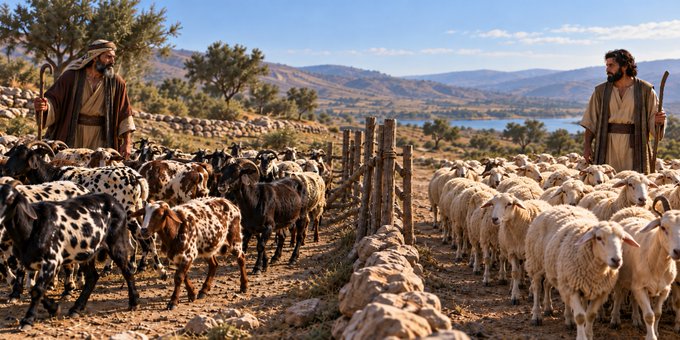
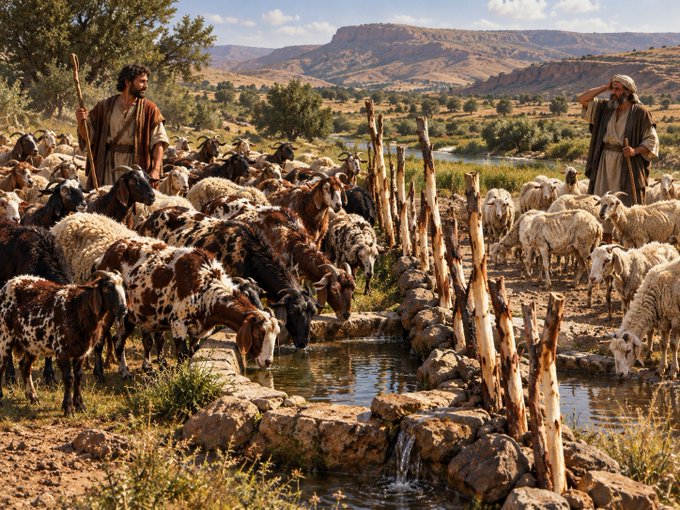
37 Then Jacob took branches of fresh poplar and almond and plane trees, and peeled white stripes in them, exposing the white in the branches.
38 Then he set the branches which he had peeled in front of the flocks in the watering troughs, where the flocks came to drink; and they mated and conceived when they came to drink.
39 So the flocks mated and conceived by the branches, and the flocks gave birth to streaked, speckled, and spotted offspring.
40 Jacob separated the lambs, and [as he had done with the peeled branches] he made the flocks face toward the streaked and all the dark or black in the [new] flock of Laban; and he put his own herds apart by themselves and did not put them [where they could breed] with Laban’s flock.
41 Furthermore, whenever the stronger [animals] of the flocks were breeding, Jacob would place the branches in the sight of the flock in the watering troughs, so that they would mate and conceive among the branches;
42 but when the flock was sickly, he did not put the branches there; so the sicker [animals] were Laban’s and the stronger Jacob’s.
43 So Jacob became exceedingly prosperous, and had large flocks [of sheep and goats], and female and male servants, and camels and donkeys.
⸻
🔬 Metabolic Commentary — Conditions Are Arranged; Increase Accumulates
Laban has already altered the starting flock. He removed the streaked, speckled, spotted, and dark animals—the animals already displaying the marks Jacob had named as his wages—and placed three days of distance between them and the flock Jacob continued to tend. The wage remains attached to a visible trait, and the animals already wearing that trait are gone. Laban has controlled what he can see.
Jacob begins working with what remains. He takes branches of poplar, almond, and plane trees, peels white stripes into them, and places them in the watering troughs. The location matters. The animals come there to drink, they gather there, and they mate there. Jacob is not creating thirst or reproductive drive. He is altering the place where those behaviors already converge. Whatever additional purpose Jacob may have attached to the peeled pattern itself, the branches are physical objects placed selectively inside the breeding space.
That impulse has shaped the chapter from the beginning. Rachel could not command her womb, so she arranged another reproductive route through Bilhah. Leah did the same through Zilpah. Rachel acquired mandrakes. Leah acquired a night with Jacob. Laban altered the starting flock. Now Jacob alters the conditions around breeding. The bodies have changed. The impulse has not. He arranges what can be arranged, and life still has to move within it.
“The flocks… gave birth to streaked, speckled, and spotted offspring.” The branches are present. The animals mate. Marked young are born. The order is clear. The mechanism is not. The branches belong to Jacob’s arrangement, but their presence alone does not explain the marked offspring.
Laban had removed the visible phenotype—the coat he could inspect—but visible appearance does not exhaust inherited variation. What an animal displays and what it may contribute to its offspring are not always identical. Laban can narrow what stands before Jacob. He cannot see everything the flock may carry forward.
Then Jacob works with what reproduction gives him. “Jacob separated the lambs.” Once marked offspring appear, he keeps his own animals apart and does not allow them to breed back into Laban’s flock. Separation changes what can meet again. What begins as marked offspring can become part of a distinct breeding group. The wage has begun to acquire a flock of its own.
The stronger and weaker animals are not treated alike. Animals in better condition may be more likely to conceive successfully, sustain pregnancy, and rear viable young, so Jacob’s preference for the stronger animals can affect which animals contribute most heavily to the next generation. What he means by “stronger” and “sickly” is left undefined, but his behavior is clear: he gives the two groups different breeding conditions. “So the sicker animals were Laban’s and the stronger Jacob’s.” Repeated separation and selective breeding change which animals contribute to what follows. One choice may be small. Repeated choices accumulate. And so do the animals.
The second half of the chapter now reflects the first. The sisters rearranged access around human reproduction. Laban rearranged the starting flock. Jacob rearranges the conditions around animal reproduction. Different people. Different bodies. The same pressure. Everyone reaches toward the conditions surrounding increase, while complete command remains out of reach.
Then comes the result: “So Jacob became exceedingly prosperous.” The flocks multiply. Servants accumulate. Camels and donkeys appear. The household that began with Rachel crying out because she had no children now ends surrounded by living increase. At the beginning, absence dominated the room. By the end, abundance fills it. Children have been born. The flock has grown. Provision has gathered around the household.
Jacob entered Laban’s household with no household of his own. Now children, servants, animals, and provision surround him. The years under Laban have produced more than wages; they have produced the material means by which a household can stand apart. But Jacob is still in Laban’s land. He has asked to go home, and he has not gone.
The means have grown. The leaving has not yet been granted.
⸻
Chapter Thesis Consolidation
The chapter begins with a demand no human being can satisfy by command: “Give me children.” From there, nearly everyone reaches for the conditions surrounding increase. Bodies are substituted, access is negotiated, fertility cues are sought, starting populations are altered, and reproductive opportunities are separated and selected.
Those interventions matter because conditions matter. But influence remains different from command. Rachel’s womb opens when God remembers her. Jacob works the conditions surrounding his flock, but life still has to reproduce within them. Life can be influenced at its edges without being owned at its center.
The household grows. The flock grows. Provision accumulates. Influence remains real. Command remains incomplete. What has been formed under that constraint now stands large enough that leaving can become the next question.